IoT Skills Gap
According to recent research, more than a third of energy companies lack the skills they need to successfully deploy IoT technology.
Technology market research firm Vanson Bourne, in a study commissioned by satellite communications provider Inmarsat, reports that the energy sector could be facing a major obstacle to IoT innovation due to a skills gap.
More than a third of the companies polled in the survey said they have trouble finding qualified people in the fields of data security, analytical data science and technical support. Vanson Bourne found that the level of unpreparedness for IoT innovation among the energy sector companies surveyed was high despite the fact that 88 percent of them are planning IoT applications and deployments.
[ Related: Are Low Code Platforms the Answer to the IT Skills Shortage? ]
“Whether they work with fossil fuels or renewables, IoT offers energy companies the potential to streamline their processes and reduce costs in previously unimagined ways. Smart sensors, for example, can facilitate the collection of information at every stage of production, enabling them to acquire a higher level of intelligence on how their operations are functioning and to therefore work smarter, more productively and more competitively,” said Chuck Moseley, senior director for energy at Inmarsat Enterprise.
Where the IoT skills gap is widest
For report on the energy sector, Vanson Bourne surveyed executives from 100 international energy companies (along with executive from the agritech, mining and transport industries — see chart below). They found that 35 percent of energy leaders believe they don’t have the management skills needed to fully use IoT, and 43 percent said they had a skills shortage at the delivery level. The skills gap was widest in the areas of security (54 percent) and tech support (49 percent). Analytic and data sciences are also in high demand.
[ Related: Why Is Big Data Analysis So Challenging? ]
“Energy companies who currently lack these capabilities in-house will find themselves in a heated recruitment battle for this talent, with Silicon Valley, in particular, offering an attractive alternative,” added Mosely. “There are undoubtedly steps that energy companies can and should take to upskill their staff and attract fresh talent with the appropriate skills, but the growing demand in the market for these skills means that bottlenecks will be hard to avoid altogether.”
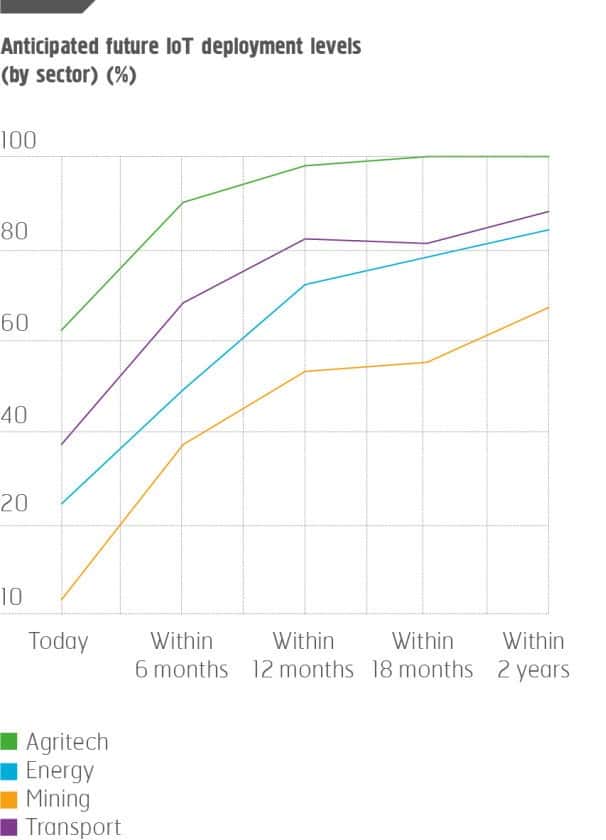
Anticipated IoT deployments by industry.
Sue Walsh is News Writer for RTInsights, and a freelance writer and social media manager living in New York City. Her specialties include tech, security and e-commerce. You can follow her on Twitter at @girlfridaygeek.

 Best Practices for Deploying and Scaling Industrial AIArtificial Intelligence (AI) is transforming industrial operations, helping organizations optimize workflows, reduce downtime, and enhance productivity. Different industry verticals leverage AI in unique ways.Link to The Center for Adaptive Edge Intelligence
 The Center for Adaptive Edge IntelligenceAdaptive edge intelligence brings real-time decision-making to the point of data creation, whether from sensors, machines, or cameras.Link to The Value of Vehicle Electrification
 The Value of Vehicle ElectrificationElectric vehicles (EVs) present automakers with many design, engineering, and manufactu ring challenges.Link to Accelerating Manufacturing Digital Transformation with Industrial Connectivity and IoT
 Accelerating Manufacturing Digital Transformation with Industrial Connectivity and IoTDigital transformation is empowering industrial organizations to deliver sustainable innovation, disruption-proof products and services, and continuous operational improvement.Link to Smart Manufacturing for Automotive
 Smart Manufacturing for AutomotiveLeading a transportation revolution in autonomous, electric, shared mobility and connectivity with the next generation of design and development tools.Link to Center for Data Pipeline Automation
 Center for Data Pipeline AutomationAs businesses become data-driven and rely more heavily on analytics to operate, getting high-quality, trusted data to the right data user at the right time is essential.Link to Center for Automated Integration
 Center for Automated IntegrationThe goal of automated integration is to enable applications and systems that were built separately to easily share data and work together, resulting in new capabilities and efficiencies that cut costs, uncover insights, and much more.Link to Continuous Intelligence: Insights
 Continuous Intelligence: InsightsDigital transformation requires continuous intelligence (CI). Today’s digital businesses are leveraging this new category of software which includes real-time analytics and insights from a single, cloud-native platform across multiple use cases to speed decision-making, and drive world-class customer experiences.