Best Practices for Deploying and Scaling Industrial AI
Artificial Intelligence (AI) is transforming industrial operations, helping organizations optimize workflows, reduce downtime, and enhance productivity. Different industry verticals leverage AI in unique ways.
Accelerating Manufacturing Digital Transformation with Industrial Connectivity and IoT
Digital transformation is empowering industrial organizations to deliver sustainable innovation, disruption-proof products and services, and continuous operational improvement.
Leading a transportation revolution in autonomous, electric, shared mobility and connectivity with the next generation of design and development tools.
As businesses become data-driven and rely more heavily on analytics to operate, getting high-quality, trusted data to the right data user at the right time is essential.
The goal of automated integration is to enable applications and systems that were built separately to easily share data and work together, resulting in new capabilities and efficiencies that cut costs, uncover insights, and much more.
Digital transformation requires continuous intelligence (CI). Today’s digital businesses are leveraging this new category of software which includes real-time analytics and insights from a single, cloud-native platform across multiple use cases to speed decision-making, and drive world-class customer experiences.
Best Practices for Deploying and Scaling Industrial AI
Artificial Intelligence (AI) is transforming industrial operations, helping organizations optimize workflows, reduce downtime, and enhance productivity. Different industry verticals leverage AI in unique ways.
Accelerating Manufacturing Digital Transformation with Industrial Connectivity and IoT
Digital transformation is empowering industrial organizations to deliver sustainable innovation, disruption-proof products and services, and continuous operational improvement.
Leading a transportation revolution in autonomous, electric, shared mobility and connectivity with the next generation of design and development tools.
As businesses become data-driven and rely more heavily on analytics to operate, getting high-quality, trusted data to the right data user at the right time is essential.
The goal of automated integration is to enable applications and systems that were built separately to easily share data and work together, resulting in new capabilities and efficiencies that cut costs, uncover insights, and much more.
Digital transformation requires continuous intelligence (CI). Today’s digital businesses are leveraging this new category of software which includes real-time analytics and insights from a single, cloud-native platform across multiple use cases to speed decision-making, and drive world-class customer experiences.
Industrial manufacturers have long used the Internet of Things to keep production lines running smoothly and operating efficiently. Now, many are expanding their use of IoT to support new cases.
Traditional use of IoT has been to monitor the health of production line equipment. Over time, more sophisticated applications like predictive maintenance and real-time data analytics of IoT data to optimize production processes, identify bottlenecks, and improve overall equipment effectiveness (OEE), were adopted.
More recently, additional use cases have become more common. Examples include:
Asset tracking and management: IoT devices can help optimize supply chains by tracking the location and status of assets, ensuring better inventory management, and reducing delays.
Improved resource utilization: IoT devices can be used to monitor the usage and location of tools and machinery to maximize their utilization and reduce idle time.
Assist energy management: IoT sensors can monitor and control energy usage across the manufacturing facility, leading to significant energy savings and reduced costs.
Environmental monitoring: IoT devices can monitor environmental conditions such as temperature, humidity, and air quality to ensure optimal conditions for production processes and worker safety.
Enhanced quality control: IoT-enabled cameras and sensors can perform real-time quality inspections during the production process, ensuring defects are caught early.
Data-driven quality assurance: IoT data can be used to analyze trends and patterns in product quality, leading to continuous improvement in manufacturing processes.
As IoT devices become more pervasive throughout industrial manufacturing plants and processes, ever-more sophisticated use cases are starting to emerge. Many of the new applications need enterprise connectivity solutions that help provide access to the IoT data from disparate devices and systems.
Once that access is assured, more things can be done with the data to support different operational and functional areas.
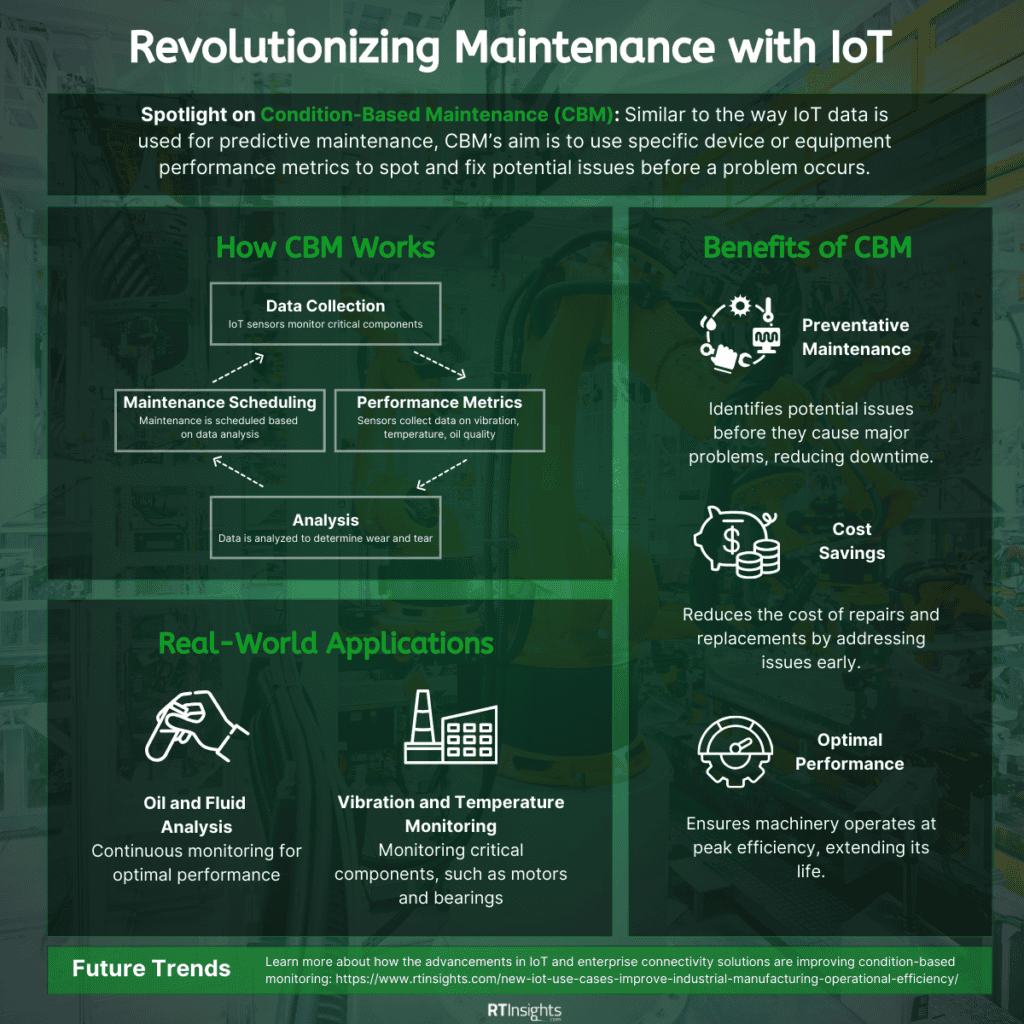
One particularly interesting emerging application is condition-based maintenance (CBM). Similar to the way IoT data is used for predictive maintenance, CBM’s aim is to use specific device or equipment performance metrics to spot and fix potential issues before a problem occurs.
One area of focus for CBM is vibration and temperature monitoring. Here, a manufacturer would use IoT sensors to monitor the condition of critical components like motors and bearings, scheduling maintenance based on actual wear and tear rather than fixed schedules.
Another focus of CBM is on oil and fluid analysis. Here, IoT data allows for the continuous monitoring of oil and other fluids to ensure optimal performance and early detection of potential issues.
Those are just the tip of the iceberg. Some examples of what is possible when an industrial manufacturer combines IoT and enterprise connectivity include:
Remote equipment management: Engineers can monitor and control machinery from remote locations, enabling quicker response times and reducing the need for on-site visits.
Distributed manufacturing: Staff can coordinate production across multiple locations through IoT, ensuring consistent quality and efficiency.
Automated replenishment: IoT sensors can trigger automatic replenishment of materials and components based on real-time usage data, thus keeping production lines and processes running without interruption.
Fleet management: IoT devices can track the location, condition, and performance of vehicles delivering raw materials, optimizing routes, and reducing fuel consumption.
Cold chain monitoring: IoT devices can monitor environments during transportation to ensure the integrity of temperature-sensitive products.
By leveraging these new capabilities and use cases, industrial manufacturers can achieve greater operational efficiency, reduce costs, and enhance overall productivity.
Salvatore Salamone is a physicist by training who writes about science and information technology. During his career, he has been a senior or executive editor at many industry-leading publications including High Technology, Network World, Byte Magazine, Data Communications, LAN Times, InternetWeek, Bio-IT World, and Lightwave, The Journal of Fiber Optics. He also is the author of three business technology books.
In this week’s real-time analytics news: Sovereign Cloud efforts in the EU are heating up. SUSE launched a Cloud Sovereignty Framework Self Assessment to help businesses understand gaps in their digital strategy.
By treating unstructured data as a strategic asset rather than an operational byproduct, enterprises can resolve the tension between innovation and control.
AI is quickly growing, and so must the enterprise environments that support it. Organizations that succeed will be those that pair innovation with governance, autonomy with accountability, and speed with structure.
Analysis and market insights on real-time analytics including Big Data, the IoT, and cognitive computing. Business use cases and technologies are discussed.
Advertiser Disclosure: Some of the products that appear on
this site are from companies from which TechnologyAdvice
receives compensation. This compensation may impact how and
where products appear on this site including, for example,
the order in which they appear. TechnologyAdvice does not
include all companies or all types of products available in
the marketplace.

 Best Practices for Deploying and Scaling Industrial AIArtificial Intelligence (AI) is transforming industrial operations, helping organizations optimize workflows, reduce downtime, and enhance productivity. Different industry verticals leverage AI in unique ways.Link to The Center for Adaptive Edge Intelligence
 The Center for Adaptive Edge IntelligenceAdaptive edge intelligence brings real-time decision-making to the point of data creation, whether from sensors, machines, or cameras.Link to The Value of Vehicle Electrification
 The Value of Vehicle ElectrificationElectric vehicles (EVs) present automakers with many design, engineering, and manufactu ring challenges.Link to Accelerating Manufacturing Digital Transformation with Industrial Connectivity and IoT
 Accelerating Manufacturing Digital Transformation with Industrial Connectivity and IoTDigital transformation is empowering industrial organizations to deliver sustainable innovation, disruption-proof products and services, and continuous operational improvement.Link to Smart Manufacturing for Automotive
 Smart Manufacturing for AutomotiveLeading a transportation revolution in autonomous, electric, shared mobility and connectivity with the next generation of design and development tools.Link to Center for Data Pipeline Automation
 Center for Data Pipeline AutomationAs businesses become data-driven and rely more heavily on analytics to operate, getting high-quality, trusted data to the right data user at the right time is essential.Link to Center for Automated Integration
 Center for Automated IntegrationThe goal of automated integration is to enable applications and systems that were built separately to easily share data and work together, resulting in new capabilities and efficiencies that cut costs, uncover insights, and much more.Link to Continuous Intelligence: Insights
 Continuous Intelligence: InsightsDigital transformation requires continuous intelligence (CI). Today’s digital businesses are leveraging this new category of software which includes real-time analytics and insights from a single, cloud-native platform across multiple use cases to speed decision-making, and drive world-class customer experiences.