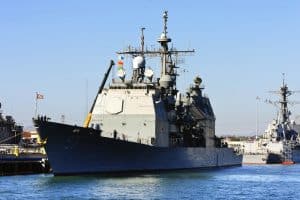
US Navy Battle Ship at San Diego Bay
A greater understanding of a machine’s life and health is critical for the military. Predictive maintenance enabled through small IoT devices will help track the health of specific parts of a ship.
The Defense Innovation Unit (DIU) intends to bring predictive maintenance to the Navy, aimed at keeping naval, aircraft and ground vehicles online and avoiding costly last-minute repairs.
Artificial intelligence has already been deployed in other areas of the U.S. Army, and the DIU is actively working to have predictive maintenance added to the Air Force fleet as well.
SEE ALSO: Why Predictive Analytics Has Eclipsed Traditional BI
Speaking at the Dell Technologies Forum on Real Transformation, DUI Director
of Strategic Engagement Mike Madsen said that they were in “very advanced discussions”
with the Navy. The organization believes it will receive a contract next year
to build the AI for the Navy.
A greater understanding of a machine’s life and health is critical for
the military, as adversaries begin to probe new ways of breaking through the
country’s defenses. The predictive maintenance may be enabled through small IoT
devices, which track the health of a specific part of the ship.
The AI would have an overview of the entire operation, with the ability
to quickly spot any abnormalities. While it is likely that most of the repair
and decision work would remain with Navy officers, having an early warning system
could avoid expensive repairs or failures in battle.
The Navy already deploys a wide range of sensors to check things like reduction gears, turbines, generators, and air conditioning plants. The DUI wants to expand that data collection, to include an overarching system that can notify Navy officers of issues.
“The performance of any given asset is something we want to hold close.
So I think what you have to do is you have to architect this from kind of the
get-go with that kind of security mindset in mind,” said Rear Adm. Lorin Selby,
a chief engineer in the Navy. “You can harvest that data and you could potentially
discover vulnerabilities, so you have to protect that. That’s part of my
project: as I do this, we’re bringing that security aspect into the program.”
David is a technology writer with several years experience covering all aspects of IoT, from technology to networks to security.

 Best Practices for Deploying and Scaling Industrial AIArtificial Intelligence (AI) is transforming industrial operations, helping organizations optimize workflows, reduce downtime, and enhance productivity. Different industry verticals leverage AI in unique ways.Link to The Center for Adaptive Edge Intelligence
 The Center for Adaptive Edge IntelligenceAdaptive edge intelligence brings real-time decision-making to the point of data creation, whether from sensors, machines, or cameras.Link to The Value of Vehicle Electrification
 The Value of Vehicle ElectrificationElectric vehicles (EVs) present automakers with many design, engineering, and manufactu ring challenges.Link to Accelerating Manufacturing Digital Transformation with Industrial Connectivity and IoT
 Accelerating Manufacturing Digital Transformation with Industrial Connectivity and IoTDigital transformation is empowering industrial organizations to deliver sustainable innovation, disruption-proof products and services, and continuous operational improvement.Link to Smart Manufacturing for Automotive
 Smart Manufacturing for AutomotiveLeading a transportation revolution in autonomous, electric, shared mobility and connectivity with the next generation of design and development tools.Link to Center for Data Pipeline Automation
 Center for Data Pipeline AutomationAs businesses become data-driven and rely more heavily on analytics to operate, getting high-quality, trusted data to the right data user at the right time is essential.Link to Center for Automated Integration
 Center for Automated IntegrationThe goal of automated integration is to enable applications and systems that were built separately to easily share data and work together, resulting in new capabilities and efficiencies that cut costs, uncover insights, and much more.Link to Continuous Intelligence: Insights
 Continuous Intelligence: InsightsDigital transformation requires continuous intelligence (CI). Today’s digital businesses are leveraging this new category of software which includes real-time analytics and insights from a single, cloud-native platform across multiple use cases to speed decision-making, and drive world-class customer experiences.