Best Practices for Deploying and Scaling Industrial AI
Artificial Intelligence (AI) is transforming industrial operations, helping organizations optimize workflows, reduce downtime, and enhance productivity. Different industry verticals leverage AI in unique ways.
Accelerating Manufacturing Digital Transformation with Industrial Connectivity and IoT
Digital transformation is empowering industrial organizations to deliver sustainable innovation, disruption-proof products and services, and continuous operational improvement.
Leading a transportation revolution in autonomous, electric, shared mobility and connectivity with the next generation of design and development tools.
As businesses become data-driven and rely more heavily on analytics to operate, getting high-quality, trusted data to the right data user at the right time is essential.
The goal of automated integration is to enable applications and systems that were built separately to easily share data and work together, resulting in new capabilities and efficiencies that cut costs, uncover insights, and much more.
Digital transformation requires continuous intelligence (CI). Today’s digital businesses are leveraging this new category of software which includes real-time analytics and insights from a single, cloud-native platform across multiple use cases to speed decision-making, and drive world-class customer experiences.
Best Practices for Deploying and Scaling Industrial AI
Artificial Intelligence (AI) is transforming industrial operations, helping organizations optimize workflows, reduce downtime, and enhance productivity. Different industry verticals leverage AI in unique ways.
Accelerating Manufacturing Digital Transformation with Industrial Connectivity and IoT
Digital transformation is empowering industrial organizations to deliver sustainable innovation, disruption-proof products and services, and continuous operational improvement.
Leading a transportation revolution in autonomous, electric, shared mobility and connectivity with the next generation of design and development tools.
As businesses become data-driven and rely more heavily on analytics to operate, getting high-quality, trusted data to the right data user at the right time is essential.
The goal of automated integration is to enable applications and systems that were built separately to easily share data and work together, resulting in new capabilities and efficiencies that cut costs, uncover insights, and much more.
Digital transformation requires continuous intelligence (CI). Today’s digital businesses are leveraging this new category of software which includes real-time analytics and insights from a single, cloud-native platform across multiple use cases to speed decision-making, and drive world-class customer experiences.
React Native vs. Ionic: Which Is the Best Cross-Platform Framework?
framework
The React Native and Ionic frameworks offer different features. Selecting the best for an application’s development will depend on the application’s properties and requirements.
Starting from VB 6.0
to mobile application development, technology has been emerging at a fast pace
in recent years. With modern-day changes, the platforms developing the user
interfaces have also become advanced and hence are more automated and more
fledged with features and functionalities. Two of such platforms to build user interfaces
are React Native and Ionic that are widely used by developers these days. Let
us have a look at the basic definition of these two:
React Native: Developed by Facebook, the React Native framework is used to develop the mobile applications for Android and iOS platforms both, under a common syntax to be followed, i.e., Javascript. Hence, the developers can now build dynamic and attractive user interfaces for both the platforms with a single code and hence reducing the efforts of writing separate codes for both.
Ionic: Ionic is an open-source framework that enables its developers to build the dynamic user interface as well as user experience on both- web applications and mobile applications. The framework provides high-end components that can be used to build the best interactive web applications as well as native applications, also known as progressive web apps. Also, it enables you to build the user interface for both Android and iOS platforms.
Having gone through
the definitions of these frameworks, let us discuss their features and
advantages of deploying them in developing applications so that we can have a
clear picture of the differences between the two. All these points are
discussed in the upcoming sections.
1) Write your code
once and use it anywhere: The code and the logic built
under the react-native framework can be executed anywhere and can be reused in
the development of similar applications too.
2) Frequent updates
available: As mentioned earlier, the framework is
developed and maintained by Facebook. Hence, the quality of the framework is
maintained by its hardcore development team, and for this, the team releases
frequent updates periodically to ensure the security, inter accessibility, code
reusability, etc., advantages in the framework.
3) A larger user community: As the framework is open to all, there are more developers across the globe utilizing it. Hence, if a developer faces any issue in developing the applications, he can easily get support from the other developers using the framework.
4) Supports
external libraries: If any functionality needs to be
incorporated in the application and is somehow not available with the
framework, then the framework allows the integration of the third party or
external APIs or libraries to implement that functionality.
5) Architecture
similar to React: The architecture of the react-native
framework resembles that of the React framework, making it more flexible and
scalable for the development team and less complicated whenever any update is
introduced in the version of the framework.
Advertisement
Advantages of
using React Native:
The advantages of React Native are as follows:
1) It is open-source: Being an open-source framework, as mentioned above, there are a large number of developers working on it, and hence, one can get the solution to any issues faced during the development phase from this community of developers. If you too want your application to be developed on React, you can hire dedicated React Native programmers and let the boat sail.
2)
High performance on mobile platforms: The architecture
of the React Native framework works well with mobile devices and hence gives
high-performance mobile applications. The framework makes use of a Graphical
Processing Unit (GPU) to develop the dynamic user interfaces as compared to
other native frameworks that are CPU intensive.
3) Live reload feature: This feature of the react-native framework enables you to see the output of the application instantaneously, even after the smallest change in the code. This is displayed in two windows, one that has the code and one that contains the output of it. Hence, you can make a change in the code and immediately observe the changes in the output due to it.
4)
Reduces the cost of development: The React Native
framework enables the developer to create a common application that can run on
Android and iOS. Hence, no need to give efforts, time, and hence the cost of
development of two separate applications for each platform.
5)
Optimal Performance of the applications: The
applications built using React Native can run on all mobile platforms. This
means the applications can easily adapt to the mobile environment in which it
is run. This gives the optimal performance of the applications in all mobile
environments.
Advertisement
Features of
Ionic
Having discussed the features and advantages of using the React Native framework, let us have a gist of the same for the Ionic framework. Its features are:
1)
It is a cross-platform framework: The applications
built on Ionic can be run on varying mobile environments, web browsers,
progressive web apps, etc. Hence, we can say it is a cross-platform framework.
2)
Based on the web standards: The base of the Ionic
framework is built using the standard technologies for web development like
HTML, CSS, and Javascript, in addition to the latest APIs. Hence, the APIs
included in the framework are considered to be stable, and hence the
applications built on them are accepted by multiple platforms.
3) Simple to learn and use: With an HTML, CSS, and Javascript base, the application development becomes easier to learn and implement if the developer has the basic knowledge of the aforementioned scripting languages.
4)
Cordova: The Ionic framework contains the plugin named
Cordova that allows the single application to run on varying platforms.
5)
License: Being an open-source framework, the Ionic
framework is registered under MIT. This means that the developer can freely
utilize the framework for their commercial and personal projects.
Advertisement
Advantages of using Ionic
The advantages of Ionic are as follows:
1)
Easily Adaptable: As mentioned earlier, the base of
the Ionic is HTML, CSS, and Javascript. Hence, any developer knowing these
three can be efficient in developing applications under Ionic in a very short
time.
2)
Dynamic User Interface: One can easily customize the
components and themes present in the Ionic, making the user interface developed
dynamic for the users.
3)
The base is AngularJS: The AngularJS, as a base for
the Ionic, has resulted in the robustness of the framework, and hence easy to
manage applications can be built.
4)
Multiple platforms supported: As mentioned in the
definition, the framework develops user interfaces that work on a web browser
as well as varying mobile platforms.
Advertisement
Comparing both the frameworks: Which one wins?
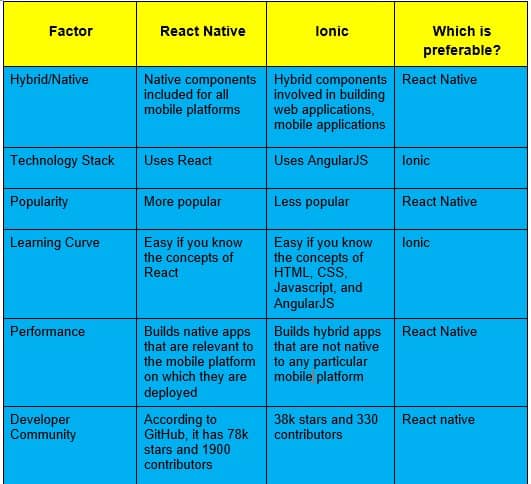
Let us discuss some factors of the development of an application and which framework fits into it from the following table:
Conclusion
From the above analysis, we can say that if there is a requirement for a mobile application that can run natively on different platforms, React Native is the best option. On the other hand, Ionic can be used if there is a requirement for an application that is compatible with web browsers and mobile platforms.
Harikrishna Kundariya is a marketer, developer, designer, IoT, chatbot, and blockchain savvy, co-founder, director of eSparkBiz @React Native Development Company. His 8+ experience enables him to provide digital solutions to new start-ups based on IoT and chatbot.
The Application Generation has arrived and they’re making it their mission to expose and eliminate poorly performing applications. Now is the time to take a look at your tech stack to ensure you are equipped to offer optimized performance, can navigate disruptions easily, and are delivering the experience that today’s users expect.
Cloud Data Insights is a community of experts for practitioners and data leaders looking to navigate the changing landscape of working with data in the cloud.
In part two of this series, Demetrios Brinkmann, MLOps Community’s Head of Community and the MC of Tecton’s apply(conf) event, shares his perspectives on the greatest challenges currently in MLOps, the role of community in solving them, and more.
The concept of “data in motion” is transforming the way organizations think about their technology stack and will determine which organizations can actually execute on AI and which are left drowning in endless streams of data.
Analysis and market insights on real-time analytics including Big Data, the IoT, and cognitive computing. Business use cases and technologies are discussed.
Advertiser Disclosure: Some of the products that appear on
this site are from companies from which TechnologyAdvice
receives compensation. This compensation may impact how and
where products appear on this site including, for example,
the order in which they appear. TechnologyAdvice does not
include all companies or all types of products available in
the marketplace.

 Best Practices for Deploying and Scaling Industrial AIArtificial Intelligence (AI) is transforming industrial operations, helping organizations optimize workflows, reduce downtime, and enhance productivity. Different industry verticals leverage AI in unique ways.Link to The Center for Adaptive Edge Intelligence
 The Center for Adaptive Edge IntelligenceAdaptive edge intelligence brings real-time decision-making to the point of data creation, whether from sensors, machines, or cameras.Link to The Value of Vehicle Electrification
 The Value of Vehicle ElectrificationElectric vehicles (EVs) present automakers with many design, engineering, and manufactu ring challenges.Link to Accelerating Manufacturing Digital Transformation with Industrial Connectivity and IoT
 Accelerating Manufacturing Digital Transformation with Industrial Connectivity and IoTDigital transformation is empowering industrial organizations to deliver sustainable innovation, disruption-proof products and services, and continuous operational improvement.Link to Smart Manufacturing for Automotive
 Smart Manufacturing for AutomotiveLeading a transportation revolution in autonomous, electric, shared mobility and connectivity with the next generation of design and development tools.Link to Center for Data Pipeline Automation
 Center for Data Pipeline AutomationAs businesses become data-driven and rely more heavily on analytics to operate, getting high-quality, trusted data to the right data user at the right time is essential.Link to Center for Automated Integration
 Center for Automated IntegrationThe goal of automated integration is to enable applications and systems that were built separately to easily share data and work together, resulting in new capabilities and efficiencies that cut costs, uncover insights, and much more.Link to Continuous Intelligence: Insights
 Continuous Intelligence: InsightsDigital transformation requires continuous intelligence (CI). Today’s digital businesses are leveraging this new category of software which includes real-time analytics and insights from a single, cloud-native platform across multiple use cases to speed decision-making, and drive world-class customer experiences.