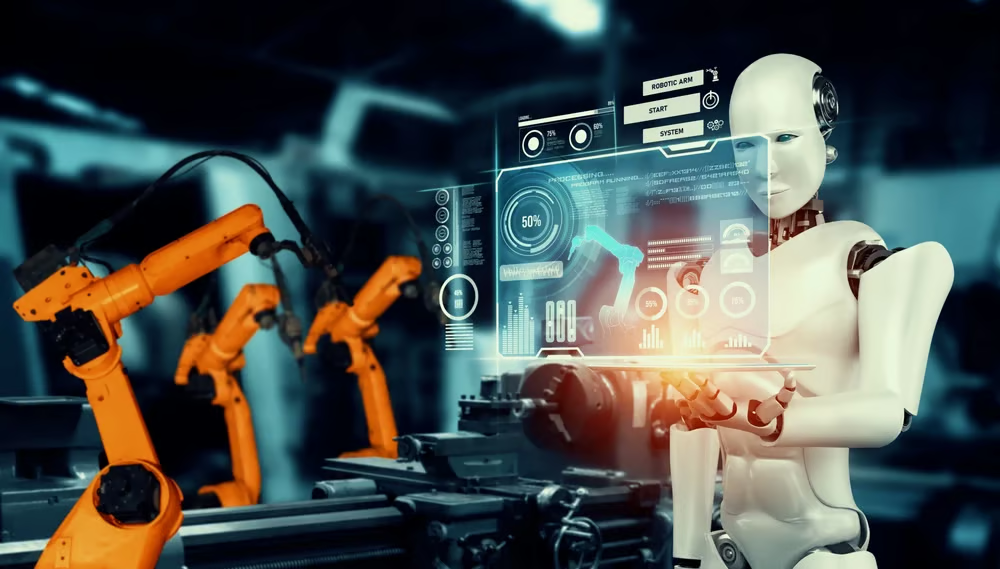
Leading manufacturers are rapidly transforming their operations by harnessing the vast volumes of data generated by connected machines, sensors, and industrial IoT (IIoT) systems. This data is becoming the core fuel for advanced analytics and AI-driven decision-making. That is the essence of smart manufacturing in 2026.
By feeding real-time and historical data into machine learning models, manufacturers can detect anomalies, predict failures, and optimize processes with a level of precision that was previously unattainable. The application of those derived insights has a measurable impact on the cost structures and operational performance. Typically, organizations that embrace these technologies reduce downtime through predictive maintenance, improve yield through process optimization, and increase efficiency through automation. Additionally, they are moving to more autonomous operations.
See also: What’s Next for Smart Factories? A Look Ahead to Industry 5.0
Why are Manufacturers Accelerating Technology Adoption?
Manufacturers have used IoT data and sophisticated analytics for decades to improve operations. So, it is fair to ask what exactly is new in 2026?
To start, the acceleration of smart manufacturing initiatives is not happening in a vacuum. A combination of economic, geopolitical, workforce, and technological factors is compelling manufacturers to invest more aggressively in digital capabilities.
First, persistent cost pressures are forcing manufacturers to rethink operational efficiency. Rising labor costs, volatile energy prices, and increasing raw material expenses are squeezing margins across industries. In response, organizations are prioritizing improvements in overall equipment effectiveness (OEE), minimizing waste and scrap, and optimizing energy consumption. Technologies such as real-time monitoring, AI-based optimization, and digital twins are becoming essential tools for systematically identifying inefficiencies and driving continuous improvement.
Second, global disruptions have fundamentally altered supply chain strategies. Geopolitical instability, trade tensions, and the aftershocks of pandemic-era disruptions have prompted many manufacturers to shift toward reshoring or regionalized production models. While this improves resilience, it often introduces higher operating costs, particularly in developed markets. To offset these costs, newly built or modernized facilities are being designed with advanced automation, robotics, and digital control systems from the outset. These “smart factories” rely heavily on integrated data platforms and AI to maintain competitiveness despite higher baseline expenses.
Third, workforce challenges are intensifying the need for technology adoption. Many industrial sectors are facing chronic labor shortages, particularly in skilled trades, compounded by aging workforces and insufficient replacement pipelines. Rather than relying solely on hiring, manufacturers are increasingly deploying automation and AI to augment human workers or, in some cases, replace repetitive and hazardous tasks altogether. Technologies such as collaborative robots (cobots), augmented reality (AR) for remote assistance, and AI-driven quality inspection systems are helping bridge the skills gap while improving safety and productivity.
Fourth, the underlying technology stack has matured significantly. Advances in industrial connectivity, including widespread adoption of standardized communication protocols and edge computing architectures, are enabling seamless data flow across production environments. At the same time, cloud platforms provide scalable infrastructure for data storage, analytics, and application deployment. This convergence of operational technology (OT) and information technology (IT) is breaking down traditional silos, enabling manufacturers to integrate shop-floor data with enterprise systems such as ERP and supply chain management systems. The result is end-to-end visibility and coordination, which is critical for real-time decision-making and optimization.
Finally, AI has emerged as a central driver of investment and innovation. Executive leadership teams are demanding tangible business outcomes. This is pushing organizations to move beyond pilot projects and deploy AI at scale across production, maintenance, quality, and supply chain functions. Use cases such as predictive maintenance, demand forecasting, process optimization, and computer vision-based inspection all deliver measurable ROI, reinforcing the business case for further investment. Importantly, AI is also enabling more autonomous operations, where systems can make and execute decisions with minimal human intervention.
See also: Top 5 Smart Manufacturing Articles of 2025
What’s Ahead for Smart Manufacturing?
Looking ahead, the smart manufacturing market is poised for sustained growth as these forces continue to intensify. The competitive landscape is evolving, with technology vendors expanding their capabilities across software, platforms, and integrated solutions to address the full manufacturing value chain. At the same time, manufacturers are increasingly favoring interoperable, ecosystem-driven approaches rather than relying on single-vendor solutions.
One key trend is the deepening integration of AI with real-time analytics at the edge. As latency-sensitive use cases grow, such as closed-loop process control and autonomous robotics, processing data closer to where it is generated will become essential. That will drive further investment in edge computing infrastructure and hybrid cloud architectures.
Another important development is the rise of digital twins and simulation technologies. By creating virtual replicas of physical assets and processes, manufacturers can test scenarios, optimize configurations, and predict outcomes before making changes in the real world. When combined with AI and real-time data, digital twins will play a critical role in enabling adaptive and self-optimizing production systems.
Ultimately, smart manufacturing is becoming a baseline requirement. Manufacturers that effectively leverage data, analytics, and AI will be better positioned to navigate cost pressures, supply chain volatility, and workforce constraints. Those that lag risk falling behind in an increasingly digital and automated industrial landscape.