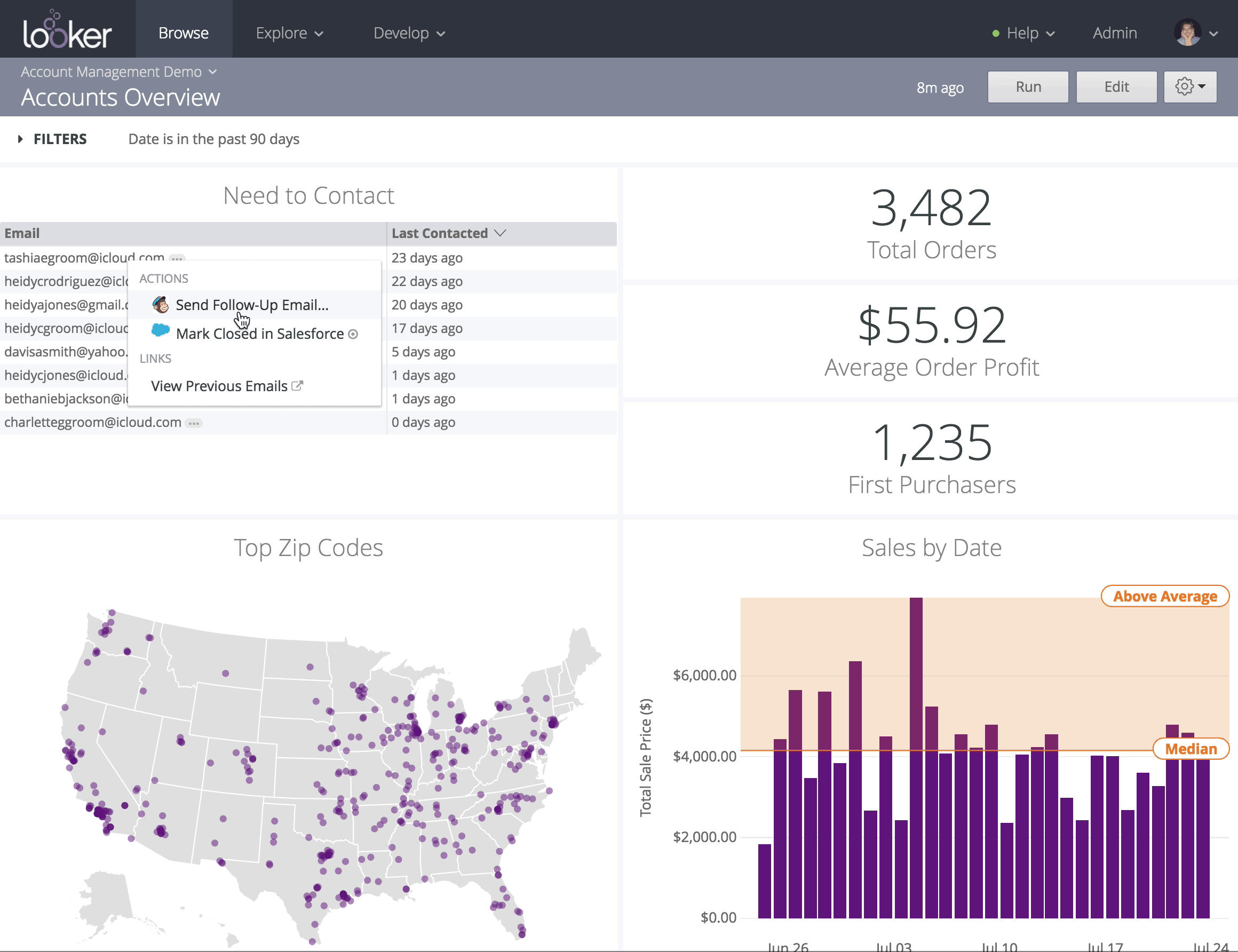
Looker on Oct. 18 unveiled its next-generation data platform, Looker 4, featuring a RESTful API that the company claims can “push data almost anywhere a user could want it.”
A new “Actions and Webhooks” function also “can pull data, charts or analysis from virtually any application, and can actually take action on the analysis they’re reviewing closing the loop between doing the analysis and then taking action based on that analysis,” the company stated.
Founded in 2012, Looker is considered a maverick among enterprise business intelligence and big data integration tools. The company places a heavy focus on ease of use, self-service analytics, and big data integration — an approach underfoothat many BI companies are adopting. (Read: “Lavastorm: Why self-service data prep is critical.”)
According to a Forrester report, Looker “challenges the need for separate technologies in order to manage, govern, and store data in a data lake.” Business users most often employ Looker’s embedded BI tools “to perform basic reporting and analysis on core business data integrated with high-velocity transitory data from web, mobile, or devices.”
The company seeks to make that happen without its business users knowing SQL. Data in a lake is modeled using LookML, a language that provides an SQL abstraction, and “Looker Blocks” offer pre-built analytics (including for marketing and Salesforce data)—a function Looker describes as a “Yellow Pages” for analytics. The company also offers a run-time for embedding Looker analytics in applications.
Getting it right the first time
According to Brian Ziel, corporate communications at Looker, the API and the Blocks functions are critical, because organizations can spend a lot of time on data cleaning just to perform an analysis. When data is extracted from a data store for visualization, “you don’t want to have to go all the way back” and do extraction all over again. With Looker, “all you have to do is refresh the data,” he said.
Looker’s current partner ecosystem includes MPP database vendors such as Teradata Aster, Google BigQuery, and HP Vertica; Hadoop specialists such as Hortonworks and Cloudera; relational databases such as Oracle and Microsoft SQL, and ETL specialists.

Looker actions. Click on picture for larger size.
Real-time business intelligence
One customer of Looker is Amazon Prime’s one-hour delivery service, which is using Looker to monitor inventory in real time “so they take things off the site when they go out of stock,” said Ziel. The data platform “is sitting on top of the data store so the data is flowing in constantly about what’s being sold.”
Another customer is Hotel Tonight, which offers last-minute hotel reservations and uses Looker to adequately price available inventory. According to a case study, Hotel Tonight moved all their user-transaction data to Amazon Redshift, an MPP database, then piped everything to Looker, which became a single source for analytics. (In some cases, analysts may move data into R for more advanced modeling and visualization).
Analysts learned that if customers use Hotel Tonight twice, they are significantly more likely to return a third time, which clarified the importance of building interactions that hook audiences early. Hotel Tonight also can determine when a hotel is priced out of competitive range, identify low-performing locations, and predict which market variables drive demand.
BI software trends: a changing landscape
Gartner’s 2016 Magic Quadrant for enterprise BI tools placed a heavy emphasis on self-service analytics, which allows average business users to discover new data insights without the need of IT involvement. Today, discovering those insights often relies on the means to integrate real-time data with easy-to-use analytic tools.
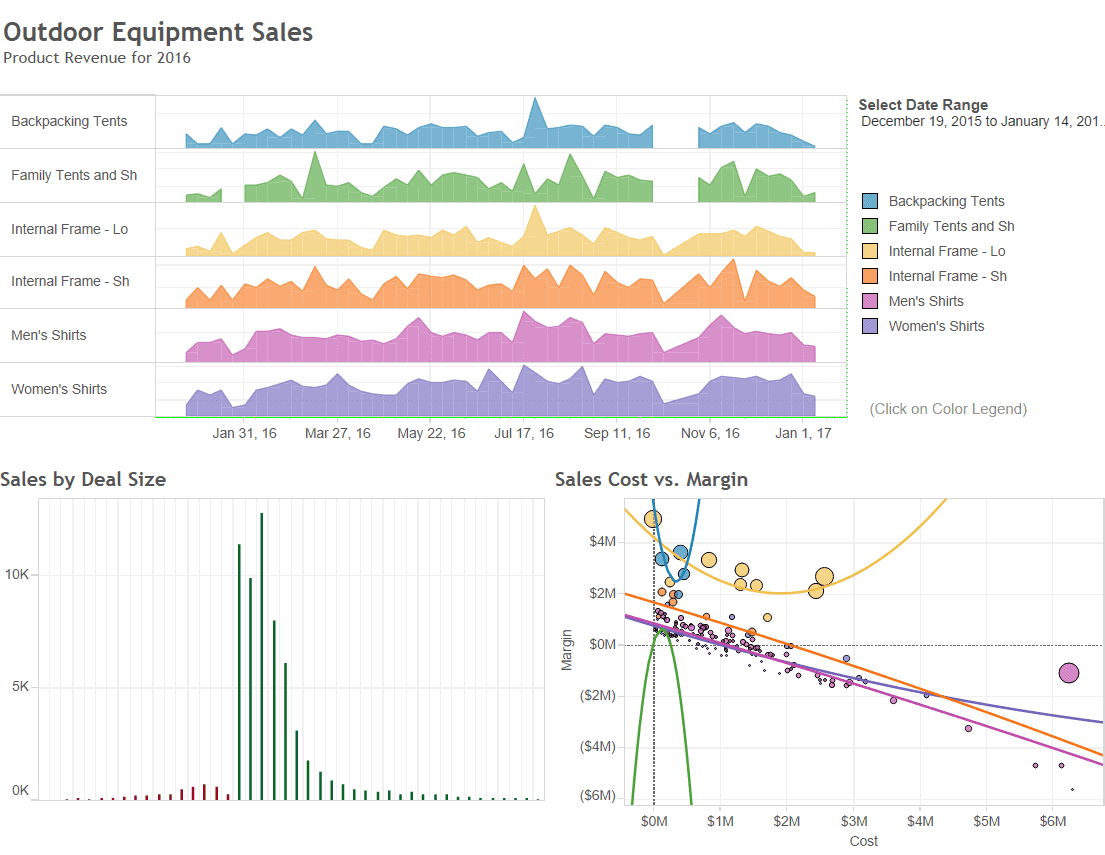
Earlier this year we spoke with Tableau, which can connect to more than 45 data sources, including Amazon Redshift, Spark SQL, several flavors of MySQL, Marklogic NoSQL “and dozens more that can all be used to provide real-time or in-memory data analysis,” said Dan Jensen, a Tableau spokesman. The tool also offers forecasting capability and can be integrated with the R language for predictive analytics.
A Tableau visualization for sales data. Click for full size or here.
As for Looker, Ziel said it will continue to roll out advanced analytics functions. While Looker is not an advanced analytics tool such as Dell Statistica or IBM Watson, the platform does offer the simplicity of leveraging any function available in an underlying data store. If for example, a source data store has user-defined functions for machine learning, you “can call those right within Looker immediately.”
Case studies: Real-time analytics in sales, marketing and ecommerce
A business intelligence strategy for real-time analytics

 Best Practices for Deploying and Scaling Industrial AIArtificial Intelligence (AI) is transforming industrial operations, helping organizations optimize workflows, reduce downtime, and enhance productivity. Different industry verticals leverage AI in unique ways.Link to The Center for Adaptive Edge Intelligence
 The Center for Adaptive Edge IntelligenceAdaptive edge intelligence brings real-time decision-making to the point of data creation, whether from sensors, machines, or cameras.Link to The Value of Vehicle Electrification
 The Value of Vehicle ElectrificationElectric vehicles (EVs) present automakers with many design, engineering, and manufactu ring challenges.Link to Accelerating Manufacturing Digital Transformation with Industrial Connectivity and IoT
 Accelerating Manufacturing Digital Transformation with Industrial Connectivity and IoTDigital transformation is empowering industrial organizations to deliver sustainable innovation, disruption-proof products and services, and continuous operational improvement.Link to Smart Manufacturing for Automotive
 Smart Manufacturing for AutomotiveLeading a transportation revolution in autonomous, electric, shared mobility and connectivity with the next generation of design and development tools.Link to Center for Data Pipeline Automation
 Center for Data Pipeline AutomationAs businesses become data-driven and rely more heavily on analytics to operate, getting high-quality, trusted data to the right data user at the right time is essential.Link to Center for Automated Integration
 Center for Automated IntegrationThe goal of automated integration is to enable applications and systems that were built separately to easily share data and work together, resulting in new capabilities and efficiencies that cut costs, uncover insights, and much more.Link to Continuous Intelligence: Insights
 Continuous Intelligence: InsightsDigital transformation requires continuous intelligence (CI). Today’s digital businesses are leveraging this new category of software which includes real-time analytics and insights from a single, cloud-native platform across multiple use cases to speed decision-making, and drive world-class customer experiences.