Best Practices for Deploying and Scaling Industrial AI
Artificial Intelligence (AI) is transforming industrial operations, helping organizations optimize workflows, reduce downtime, and enhance productivity. Different industry verticals leverage AI in unique ways.
Accelerating Manufacturing Digital Transformation with Industrial Connectivity and IoT
Digital transformation is empowering industrial organizations to deliver sustainable innovation, disruption-proof products and services, and continuous operational improvement.
Leading a transportation revolution in autonomous, electric, shared mobility and connectivity with the next generation of design and development tools.
As businesses become data-driven and rely more heavily on analytics to operate, getting high-quality, trusted data to the right data user at the right time is essential.
The goal of automated integration is to enable applications and systems that were built separately to easily share data and work together, resulting in new capabilities and efficiencies that cut costs, uncover insights, and much more.
Digital transformation requires continuous intelligence (CI). Today’s digital businesses are leveraging this new category of software which includes real-time analytics and insights from a single, cloud-native platform across multiple use cases to speed decision-making, and drive world-class customer experiences.
Best Practices for Deploying and Scaling Industrial AI
Artificial Intelligence (AI) is transforming industrial operations, helping organizations optimize workflows, reduce downtime, and enhance productivity. Different industry verticals leverage AI in unique ways.
Accelerating Manufacturing Digital Transformation with Industrial Connectivity and IoT
Digital transformation is empowering industrial organizations to deliver sustainable innovation, disruption-proof products and services, and continuous operational improvement.
Leading a transportation revolution in autonomous, electric, shared mobility and connectivity with the next generation of design and development tools.
As businesses become data-driven and rely more heavily on analytics to operate, getting high-quality, trusted data to the right data user at the right time is essential.
The goal of automated integration is to enable applications and systems that were built separately to easily share data and work together, resulting in new capabilities and efficiencies that cut costs, uncover insights, and much more.
Digital transformation requires continuous intelligence (CI). Today’s digital businesses are leveraging this new category of software which includes real-time analytics and insights from a single, cloud-native platform across multiple use cases to speed decision-making, and drive world-class customer experiences.
AI is an integral part of Digital Process Automation, and the potential of AI optimizations for on-chain (Blockchain transactions) and off-chain data (IoT, customer, etc.) are tremendous.
There is a lot of speculation about the impact of Artificial
Intelligence on Blockchain. Part of the problem is the folklore surrounding
Artificial Intelligence and Blockchain.
Here we elaborate on someof the core
synergies between Blockchain and AI – focusing primarily on the advantages of
AI for all the layers of a robust Blockchain reference architecture. The
business value of the AI is realized in the context of end-to-end value chains.
End-to-End value chains orchestrating people, enterprise
applications, trading partners – while leveraging Blockchains and IoT/IIoT – is
where the Internet of Value achieves its full potential. Value chains are
business processes that are digitized and automated through a Digital Process
Automation platform. AI is the nervous system of the value chains.
AI
AI has been around since the mid-1950s!
The well-known and respected Association of Artificial
Intelligence (AAAI) was established in 1979. But AI had lots of ups and
downs with the associated hype. There was a time when rule-based Expert
Systems were predicted to take over the world. They didn’t. However, more
recently, we are seeing an incredible rekindling of
interest and deployment of AI. A perfect storm of technological advances in
computing, databases, and networking have caused the emergence of AI as one of
the most significant digital transformation trends. However, the hype is still
there! It is amazing that even after so many years, there is still some
confusion as to exactly what should be considered “AI.”
Artificial Intelligence, at its core, is trying to emulate
humans: make intelligent decisions, sense, see, move, carry out tasks, talk,
and interact like humans. One of the major areas impacted by AI is work. AI can be the core engine for automation
– either through physical robots or software robots, also known as Robotic
Process Automation; or through intelligent
virtual assistants for AI-assisted work; or through involving cognitive
workers who think for a living. There is
no question that many repetitive and well-defined tasks will eventually be
replaced through AI-enabled automation: these span smart manufacturing shop
floor functions to front or back-office repetitive tasks. AI also attempts to
learn continuously. The ultimate objective is to make it difficult in specific
highly technical or specialized domains (work) to distinguish between AI and
humans. Furthermore, robust AI systems can intelligently correlate and respond
to real-time events. The combination of analytical – especially predictive –
models with real-time event processing is a powerful enabler for responsive
systems. In many applications, AI is providing augmentation and assistance
to humans.
Of course, AI can be applied in all areas within consumer
and enterprise applications – not just work automation. However, as Blockchain
evolves into value chain the emphasis on intelligent automation becomes
imperative. This spectrum of automation enabled and empowered through AI, is critical
to Blockchain solutions – discussed next.
Advertisement
Blockchain
Blockchain also has its own share of speculation, connotations, and confusion. Blockchain is a type of distributed and decentralized ledger. Each Blockchain involves many copies of a decentralized ledger database that exist on nodes all around the globe. Compared to AI, Blockchain is in its infancy. Blockchain traces its inception to Cryptocurrencies – and especially Bitcoin. It was launched only about a decade ago, and the first-ever block of the Bitcoin Blockchain was unleashed by Satoshi Nakamoto on January 3, 2009. We still do not know exactly who is (or who are) the famous inventor(s) of Bitcoin – which is amazing in the digital era of leaks and disclosures! Whoever this person(s) is (are), they are good communicators.
There are many salient characteristics of Blockchains, and
part of the confusion is that “Blockchain” connotes many disciplines and
technologies. Artificial Intelligence is relevant to each one of these but
impacts them differently. In addition to
the peer-to-peer decentralized and disintermediated recording of transactions, some
Blockchains also execute Smart Contracts. Smart
contracts are the policies, rules, and mutual agreements between parties that
get executed in the Blockchain.
Advertisement
Sources of “Intelligence”
Before delving into this important synergy between
Blockchain and AI, we need to frame the sources of intelligence. There are four
main sources, and each of these has a tremendous impact on Blockchain
applications.
Regulations, Knowledge, Policies,
& Procedures: There is an enormous amount of knowledge in
written documents. In any application domain or industry, there are policy and
procedure manuals with inherent and embedded knowledge. This spans operations
manuals, organizational procedures, as well as regulatory compliance documents.
Rules-based systems, as well as language processing, can be leveraged to
extract the knowledge and then operationalize it in Blockchain applications. Blockchain
Smart Contracts can be
leveraged to digitize the business rules in the Policies & Procedures (e.g.,
by-laws or operational regulations) and execute them on the Blockchain. For
more complex policies, declarative business rules can digitize the policies and
work in conjunction with Smart Contracts.
Human Intelligence: Cognitive
workers – people who use data or information to do their jobs – have a lot of
deep knowledge in their heads that needs to be harvested. As noted above, AI-assisted
human work often digitizes the knowledge of cognitive workers. Their expertise
also needs to be understood, digitized, and operationalized, sometimes in
intelligent virtual assistants or bots. Blockchain
Decentralized
Applicationscan leverage the cognitive workers’ knowledge either through the
digitization of business rules or through fully or semi-automated intelligent
assistants. Cognitive workers participate in end-to-end digitized value streams
– operationalized through Digital Processes Automation (DPA).
Legacy Code: Another important
source of business intelligence is embedded in legacy code that contains
business logic. The embedded policies can become ossified, with little or no
business visibility. They are difficult to change or extend. The challenge is
to leverage the intelligence in legacy systems while allowing the organization
to modernize and be agile. Blockchain Architectures involve orchestration of Smart Contracts
with API invocations of AI decisions through secure exchanges. Here again, the DPA
layer can be an intelligent modernization bridge between legacy applications and Blockchain
messaging – much the same way it is now with business-to-business protocols.
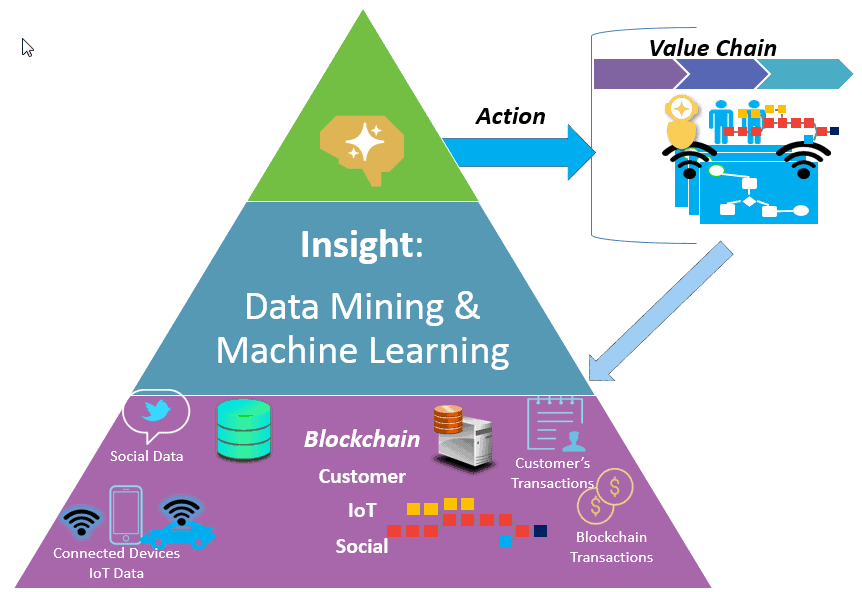
Data: Blockchain stores all the business transactions: the addresses
of the senders/receivers of exchanges, if applicable, the amounts of exchanges,
the meta-data of transactions, and the execution of code in the Blockchain,
etc. The chain in Blockchain only
grows and is never deleted. Information cannot be modified. Only validated
blocks can be added to the Blockchain. So, each Blockchain grows. Blockchain
Data
Mining and Machine Learningtechniques with Blockchain transaction
data sets are a tremendous source of intelligence. There are patterns of knowledge
and intelligence hidden in the Blockchain data. AI can learn from the
Blockchain data and potentially predict outcomes (positive or adverse) before
they happen. Decisions based on AI predictions can be fed back to the data
source to improve the precision of the predictions continuously.
Blockchain is an important and robust source of ever-growing
data to mine or gain intelligence from a plethora of AI techniques. However,
there are other sources of data. Some of these sources include social networks,
connected
devices (IoT/IIoT), business application transaction data – and more. Combining
and aggregating these data sources with Blockchain transactions constitute the
“raw” Big Data for analysis. No easy task but a tremendous source of continuous
optimization of Blockchain solutions. Data mining, as well as machine learning,
can then generate and optimize the intelligent decision models.
There is a caveat, though. Even after the combination and
aggregation of the data involving Blockchains, the value of the discovered or analyzed models can be achieved only
through execution. The AI decision models need to be made the “nervous system”
of end-to-end value streams that are digitized and operationalized through DPA.
From all of the aforementioned sources of intelligence, the discovery of intelligence needs to be followed with action in Value Chains
This action is the execution of decisions in the context of
end-to-end value streams orchestrating people, enterprise applications,
devices, robots, and of course, the Blockchain! Each is carrying specific tasks
assigned to them through the underlying AI-enabled DPA.
Advertisement
Example: Warranty Value Chain
We wrap up with a pragmatic example: the application of
Blockchain AI in Warranty Value Chains. You can read the details of Warranty
Value Chains here.
This innovative solution was created through
the strategic partnership between Pegasystems Inc., Samsung SDS, and Tech
Mahindra.
Warranty management has been one of the most significant
expenses for manufacturing companies. Despite a reduction in the number of
claims issued, there has been a noted increase in costs across the warranty
value chain. Existing legacy systems are disparate or standalone, requiring
manual interventions and hand-offs, with zero immutability of records. The onus is transferred to the customer to
prove ownership and warranty coverage to OEMs via physical invoices,
contributing to decreased customer satisfaction, duplication of work, and
inability to handle counterfeiting and fraudulent claims. The dual combination
of DPA + blockchain aims to target these inefficiencies by optimizing the
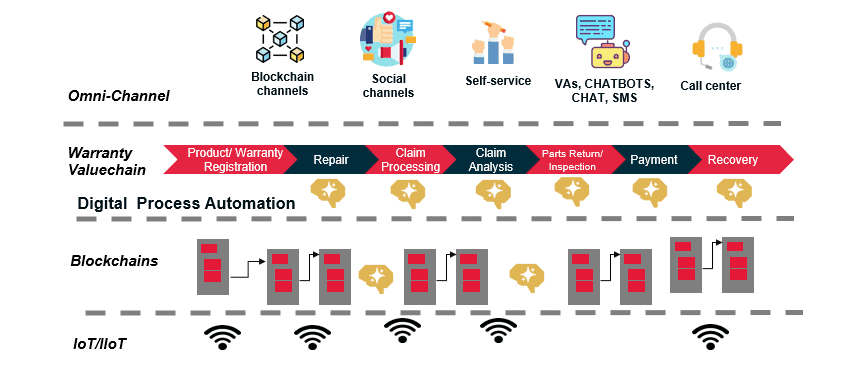
warranty value chain. Organizations gain the power to track the part with a
digital twin for the entire lifecycle of the warranty value chain, as
illustrated here.
How about AI? There are multiple opportunities and use cases
for all categories of AI in Warranty Value chains:
Warranty
Business Rules and Policies: these are decision tables, decision trees,
constraints, calculations, and expressions, etc. that are authored by Warranty
experts. Business rules can be leveraged in all the milestones of the Warranty
Value Chain.
Predictive
Analytics for Repairs: The connected device IoT Data can be mined for
predictive analytic models that can be digitized and automated in especially
the repair milestone of the Warranty Value Chain.
Machine
Learning and Adaptive Analytics: In addition, the combination of business
rules, predictive models, and continuous learning feedback loops can be leveraged
to prevent repairs ahead of time and avoid costly fixes for devices or vehicles
under Warranty.
Customer
Experience Next-Best-Actions: The customer context and customer
interactions are another source of data that could be analyzed for both
predictive and machine learning prioritization for actions that optimize the
customer experience.
Blockchain
Ledger Analytics: The transactions that are recorded on the Blockchain for
the entire value chain are another rich source of potential predictive and
machine learning models that could be periodically analyzed to optimize the
entire value chain.
AI is an integral part of Digital
Process Automation, and the potential of AI optimizations for on-chain
(Blockchain transactions) and off-chain data (IoT, customer, etc.) are
tremendous. AI is the nervous system that automates and drives end-to-end
digitized value chains to successful completion.
Dr. Setrag Khoshafian is Principal and Chief Scientist at Khosh Consulting. He is a pioneer and recognized expert in the transformation of innovative and agile enterprises. He has invented pragmatic approaches for innovation and cultural transformation through a holistic approach leveraging Intelligent Business Process Management, Intelligent Database Management, Internet of Things (IoT), Blockchain, AI, Low Code/No Code, Service-Oriented Architectures and Automation. Previously he was the Chief Evangelist & VP of BPM at Pegasystems Inc., the Senior VP of Technology at Savvion, and Chief Scientist & VP of Development at Portfolio Technologies.
Dr. Khoshafian is an author, thought leader, keynote speaker, and educator who has helped the cultural transformation journeys of entrepreneurial enterprises leveraging digital technologies.
He has been a senior executive in the software industry for the past 30 years, where he has invented, architected, and steered the production of several enterprise software products and solutions.
He is well recognized and quoted frequently for his contributions in Intelligent BPMS, Intelligent DBMS, Blockchain, IoT, AI, and Service-Oriented Enterprises.
Dr. Khoshafian is a frequent speaker and presenter at international workshops and conferences. He is the lead author of more than 10 books and hundreds of publications in various industry and academic journals.
He has also been full-time as well as adjunct professor in several universities across the globe. Dr. Khoshafian holds a PhD in Computer Science from the University of Wisconsin-Madison. He also holds MSc in Mathematics from AUB.
Twitter: @setrag
Linked In: https://www.linkedin.com/in/setrag
By reducing costs, increasing transparency, and improving efficiency, blockchain has the potential to revolutionize the way businesses manage their supply chains.
In a digital environment where trust is difficult to create and maintain through relationships, experience, or actions alone, DLT is essential for cross-collaboration and enterprise innovation.
Analysis and market insights on real-time analytics including Big Data, the IoT, and cognitive computing. Business use cases and technologies are discussed.
Advertiser Disclosure: Some of the products that appear on
this site are from companies from which TechnologyAdvice
receives compensation. This compensation may impact how and
where products appear on this site including, for example,
the order in which they appear. TechnologyAdvice does not
include all companies or all types of products available in
the marketplace.

 Best Practices for Deploying and Scaling Industrial AIArtificial Intelligence (AI) is transforming industrial operations, helping organizations optimize workflows, reduce downtime, and enhance productivity. Different industry verticals leverage AI in unique ways.Link to The Center for Adaptive Edge Intelligence
 The Center for Adaptive Edge IntelligenceAdaptive edge intelligence brings real-time decision-making to the point of data creation, whether from sensors, machines, or cameras.Link to The Value of Vehicle Electrification
 The Value of Vehicle ElectrificationElectric vehicles (EVs) present automakers with many design, engineering, and manufactu ring challenges.Link to Accelerating Manufacturing Digital Transformation with Industrial Connectivity and IoT
 Accelerating Manufacturing Digital Transformation with Industrial Connectivity and IoTDigital transformation is empowering industrial organizations to deliver sustainable innovation, disruption-proof products and services, and continuous operational improvement.Link to Smart Manufacturing for Automotive
 Smart Manufacturing for AutomotiveLeading a transportation revolution in autonomous, electric, shared mobility and connectivity with the next generation of design and development tools.Link to Center for Data Pipeline Automation
 Center for Data Pipeline AutomationAs businesses become data-driven and rely more heavily on analytics to operate, getting high-quality, trusted data to the right data user at the right time is essential.Link to Center for Automated Integration
 Center for Automated IntegrationThe goal of automated integration is to enable applications and systems that were built separately to easily share data and work together, resulting in new capabilities and efficiencies that cut costs, uncover insights, and much more.Link to Continuous Intelligence: Insights
 Continuous Intelligence: InsightsDigital transformation requires continuous intelligence (CI). Today’s digital businesses are leveraging this new category of software which includes real-time analytics and insights from a single, cloud-native platform across multiple use cases to speed decision-making, and drive world-class customer experiences.