Given that the Internet of Things is expected to be a $14. 4 trillion market in the next five years, it’s not surprising to see enterprise software giants embarking on land grabs. There’s Cisco-Jaspersoft; Cisco-ParStream; a collaboration between GE and Microsoft; and a strategic partnership between C3 IoT and Amazon Web Services.
One acquisition, announced Sept. 28, is SAP’s purchase of Plat.One, a small IoT startup. The under-the-radar acquisition of course reinforces the importance of the cloud in IoT deployments, but it also speaks volumes about two lesser-known but crucial aspects of the IoT: edge computing and device interoperability.
“We conducted a review of IoT platforms in the market and found PLAT.ONE to be a strong leader, particularly in device interoperability, edge processing capabilities and development capabilities,” said Bjoern Goerke, SAP’s executive vice president of product and innovation technology.
Edge processing
Plat.One has an IoT platform that communicates with over 40 machine protocols. A micro-services-based adaptive architecture can run logic on a device, at the edge (such as a router or gateway) or in the cloud.

Dr. John Bates
In an interview with RTInsights, Dr. John Bates, CEO of Plat.One, gave the example of a smart parking application. While the cloud may be used for big-data analytics, the application may not want to send video on available spaces to the cloud since it runs into bandwidth issues trying to do so over a wireless network. Or, in the case of low-power networks, such as SIGFOX or LoRa, an edge device may want to perform local analytics or pre-filter data.
Bates further noted that edge processing comes in handy when a device disconnects from the cloud.
What happens, he said, “when you want your city systems to keep operating and the connectivity required is not there?”
A plug-and-play approach for enterprise IoT
For IoT projects, device interoperability is a standard gremlin: With so many different machine-to-machine protocols, the inability to get devices accurately relaying data on a network has been known to mire IoT projects with complexity and costs. Plat.One developed the ability to integrate over 40 different machine protocols by working on a wide variety of IoT projects in logistics, cities, smart farming, and smart factories.
A smart lighting project, for example, may involve different lighting vendors with different machine protocols and network connections. Plat.One’s platform manages that complexity, allowing communication between the devices and platform.
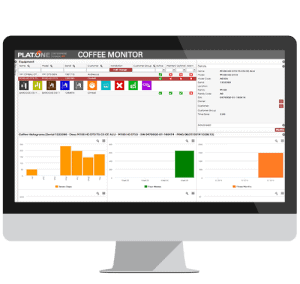
A Plat.One dashboard to manage edge devices–in this case coffee vending machines.
With Plat.One, “you can plug these things together quickly,” Bates said.
The company also has the ability to learn new IoT protocols quickly, a capability that entails listening to the sensor to learn what is normal and what is anomalous. “It’s like a machine-learning capability,” Bates explained. “You can start to listen to the protocols, and with a custom protocol, it can take a couple of days [to learn] as opposed to several months.” That avoids a situation where an IoT project runs out of time (and funding) to become operational just because devices couldn’t communicate properly.
The platform further offers a graphical modeling environment in which the “things” are business objects, Bates said. This will also “future-proof” IoT projects because they won’t be fettered to specific protocols and device details.
A more powerful IoT business
SAP pioneered in-memory data analytics through its HANA database, then launched the HANA Cloud Platform, which enables runtime services and development for IoT projects.
Combine the two companies, and HANA cloud can now allow IoT-enabled business applications throughout an enterprise — from the cloud to the edge.
Beyond SAP merely acting as a global propagator of Plat.One’s IoT capabilities, it can now link them to other business applications. SAP excels at a wide variety of business software, including for enterprise resource planning, human resources, supply-chain management — the list goes on. (SAP has an entire page devoted to its products that have been named to Gartner’s Magic Quadrant, and the page requires a lot of scrolling).
“SAP can dominate the IoT space because of its unique footprint,” Bates said. “Nobody has the business apps that SAP does.”
For instance, Bates said, traditional ERP and human resources are not connected to real-world things. But consider a factory or truck: With edge processing, you can now connect the truck to the factory, and rather than guessing how much fuel has been used, or the condition of the truck, you can actually get that information in real time.
“That completely revolutionizes ERP,” Bates said.

 Best Practices for Deploying and Scaling Industrial AIArtificial Intelligence (AI) is transforming industrial operations, helping organizations optimize workflows, reduce downtime, and enhance productivity. Different industry verticals leverage AI in unique ways.Link to The Center for Adaptive Edge Intelligence
 The Center for Adaptive Edge IntelligenceAdaptive edge intelligence brings real-time decision-making to the point of data creation, whether from sensors, machines, or cameras.Link to The Value of Vehicle Electrification
 The Value of Vehicle ElectrificationElectric vehicles (EVs) present automakers with many design, engineering, and manufactu ring challenges.Link to Accelerating Manufacturing Digital Transformation with Industrial Connectivity and IoT
 Accelerating Manufacturing Digital Transformation with Industrial Connectivity and IoTDigital transformation is empowering industrial organizations to deliver sustainable innovation, disruption-proof products and services, and continuous operational improvement.Link to Smart Manufacturing for Automotive
 Smart Manufacturing for AutomotiveLeading a transportation revolution in autonomous, electric, shared mobility and connectivity with the next generation of design and development tools.Link to Center for Data Pipeline Automation
 Center for Data Pipeline AutomationAs businesses become data-driven and rely more heavily on analytics to operate, getting high-quality, trusted data to the right data user at the right time is essential.Link to Center for Automated Integration
 Center for Automated IntegrationThe goal of automated integration is to enable applications and systems that were built separately to easily share data and work together, resulting in new capabilities and efficiencies that cut costs, uncover insights, and much more.Link to Continuous Intelligence: Insights
 Continuous Intelligence: InsightsDigital transformation requires continuous intelligence (CI). Today’s digital businesses are leveraging this new category of software which includes real-time analytics and insights from a single, cloud-native platform across multiple use cases to speed decision-making, and drive world-class customer experiences.