Getting robots to learn is quite similar to how we teach humans, and UC Berkeley may have found a way to speed up the process with deep learning.
Getting robots to complete tasks involves a lot of human-like training, essentially showing the task to the robot and having it repeat and repeat. But there are steps in-between that can speed up the process, researchers at the University of California Berkeley have published another one.
Named AVID, the framework is based on two deep-learning models also developed by UC Berkeley, CycleGAN and SOLAR. CycleGAN reduces images of a human performing a task to the pixel level, which can then be restructured to show the robot completing the same task.
SEE ALSO: IBM Robot Returns To International Space Station
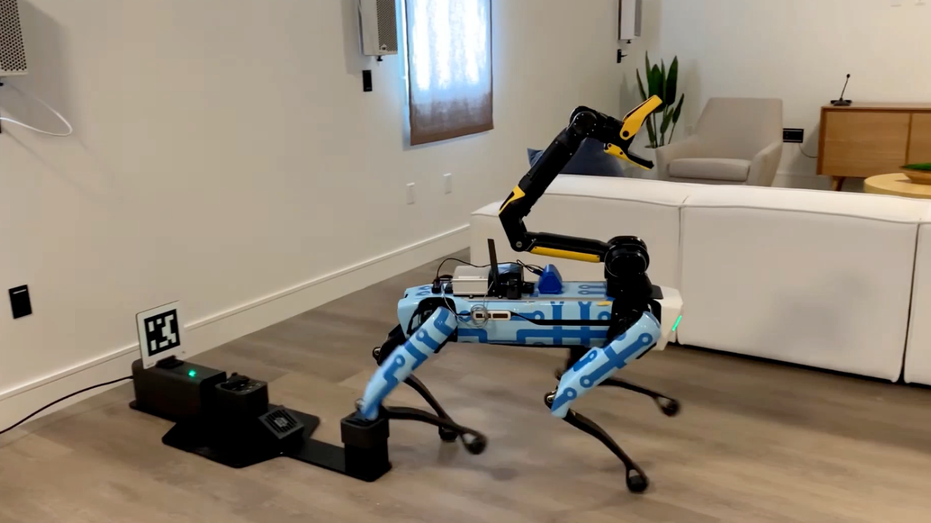
“AVID works by having the robot observe a human perform some task then imagine what it’d look like for itself to perform the same thing,” said UC Berkeley robotics research assistant, Laura Smith. “To learn how to actually achieve this imagined success, we let the robot learn by trial and error.”
Instead of having the human operator reset the task each time the robot fails, the robot automatically resets it. This reduces the amount of intervention needed when setting a task, allowing some form of autonomy. “We design our training framework to be amenable to learning long-term behavior with minimal effort,” said Smith.
In tests, AVID was able to outperform pixel-space ablation, TCN, imitation ablation, and robot demonstrations with observations. Moreover, it managed to complete these tasks with far less direct intervention from humans, which could be useful for developers looking to program thousands of robots to perform tasks.
One of the limitations of the current form of AVID is that robots need to be taught every task, and the knowledge learned cannot be passed on to new tasks. In the future, Smith and her colleagues hope to make CycleGAN training a one-time exercise for a wide range of tasks and skills.
David is a technology writer with several years experience covering all aspects of IoT, from technology to networks to security.

 Best Practices for Deploying and Scaling Industrial AIArtificial Intelligence (AI) is transforming industrial operations, helping organizations optimize workflows, reduce downtime, and enhance productivity. Different industry verticals leverage AI in unique ways.Link to The Center for Adaptive Edge Intelligence
 The Center for Adaptive Edge IntelligenceAdaptive edge intelligence brings real-time decision-making to the point of data creation, whether from sensors, machines, or cameras.Link to The Value of Vehicle Electrification
 The Value of Vehicle ElectrificationElectric vehicles (EVs) present automakers with many design, engineering, and manufactu ring challenges.Link to Accelerating Manufacturing Digital Transformation with Industrial Connectivity and IoT
 Accelerating Manufacturing Digital Transformation with Industrial Connectivity and IoTDigital transformation is empowering industrial organizations to deliver sustainable innovation, disruption-proof products and services, and continuous operational improvement.Link to Smart Manufacturing for Automotive
 Smart Manufacturing for AutomotiveLeading a transportation revolution in autonomous, electric, shared mobility and connectivity with the next generation of design and development tools.Link to Center for Data Pipeline Automation
 Center for Data Pipeline AutomationAs businesses become data-driven and rely more heavily on analytics to operate, getting high-quality, trusted data to the right data user at the right time is essential.Link to Center for Automated Integration
 Center for Automated IntegrationThe goal of automated integration is to enable applications and systems that were built separately to easily share data and work together, resulting in new capabilities and efficiencies that cut costs, uncover insights, and much more.Link to Continuous Intelligence: Insights
 Continuous Intelligence: InsightsDigital transformation requires continuous intelligence (CI). Today’s digital businesses are leveraging this new category of software which includes real-time analytics and insights from a single, cloud-native platform across multiple use cases to speed decision-making, and drive world-class customer experiences.