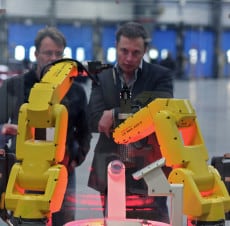
Elon Musk, Tesla Motors CEO, at a FANUC manufacturing facility. Photo: Steve Jurvetson.
The Internet of Things is poised for solid growth through 2019. Trends in IoT applications include smart manufacturing, electric vehicles, energy savings technology, and health care.
A new report looking at market growth for the Internet of Things segments the IoT industry into four end-user segments—manufacturing, energy and utilities, automotive and transportation as well as healthcare—and forecasts a 26.56 percent compound annual growth rate to 2019.
The report further stated that “The growing adoption of industrial IoT (IIoT) in the market may lead to a shift in employment structures. A blended workforce is expected where both humans and machines work together to attain outcomes that neither humans nor machines could produce alone.”
The notion is that technology will likely be designed and applied to empower people rather than replace them. It’s likely that the increased usage of smart devices, intelligent systems, and robots will completely transform the skills and jobs required in the future.
So, what does this change look like? It’s really just a progression of the current trends.
IoT Applications: Robots, Cars, Thermostats, and Health Care
Manufacturing will see more use of industrial robots and other devices that make it easier build things. This has been an evolving space for the last 20 years. Over the next five years, this evolution will only accelerate. Count on inventory-control technology based on RFID to be more of a factor, and automated manufacturing systems that can operate autonomously.
Energy and utilities will see a significant change in energy savings technology. For instance, the Nest intelligent home thermostats can provide load-shedding capabilities to homeowners who enroll in the program. They will get credits for participating in the program, and electric companies can avoid building new power plants to deal with expanding demand.
Other energy-related innovations will include new appliances that are connected to the grid. These appliances will manage themselves based upon demands on the electric grid, and become good grid citizens in that they use more power during non-peak times, while monitoring their functions to make sure they provide value to their owners. Connected refrigerators would be an example.
Automotive and transportation will grow around the use of alternative energy, such as electric-powered vehicles. One of the disadvantages has been lack of range, and the time it takes to charge. Both problems are solved with better intelligence built into the automobiles, such as faster charging using computer-monitored charging systems, and better battery management.
Healthcare has the most opportunities to improve with IoT. This includes the huge growth in healthcare telemetry, including all of the activity monitors that people wear these days. Count on more advanced devices that can take blood pressure and other more telling health metrics. The data can be used to closely monitor everyone, with guidance provided around weight loss and other desired changes. More importantly, analysis and manipulation of this data could determine health issues before they become damaging, such as heart attack or stroke.
Clearly, IoT is a quickly growing space. It will follow the same path as cloud and Big Data in terms of interest. Devices and humans need to get together to make the most of this all-important technological trend.
Want more? Check out our most-read content:
Research from Gartner: Real-Time Analytics with the Internet of Things
Smart Cities: Managing Traffic in China
Becoming an ‘Always On’ Smart Business
Webinar Replay: Better Business Insight with Real-Time Streaming Analysis
Liked this article? Share it with your colleagues using the links below!

 Best Practices for Deploying and Scaling Industrial AIArtificial Intelligence (AI) is transforming industrial operations, helping organizations optimize workflows, reduce downtime, and enhance productivity. Different industry verticals leverage AI in unique ways.Link to The Center for Adaptive Edge Intelligence
 The Center for Adaptive Edge IntelligenceAdaptive edge intelligence brings real-time decision-making to the point of data creation, whether from sensors, machines, or cameras.Link to The Value of Vehicle Electrification
 The Value of Vehicle ElectrificationElectric vehicles (EVs) present automakers with many design, engineering, and manufactu ring challenges.Link to Accelerating Manufacturing Digital Transformation with Industrial Connectivity and IoT
 Accelerating Manufacturing Digital Transformation with Industrial Connectivity and IoTDigital transformation is empowering industrial organizations to deliver sustainable innovation, disruption-proof products and services, and continuous operational improvement.Link to Smart Manufacturing for Automotive
 Smart Manufacturing for AutomotiveLeading a transportation revolution in autonomous, electric, shared mobility and connectivity with the next generation of design and development tools.Link to Center for Data Pipeline Automation
 Center for Data Pipeline AutomationAs businesses become data-driven and rely more heavily on analytics to operate, getting high-quality, trusted data to the right data user at the right time is essential.Link to Center for Automated Integration
 Center for Automated IntegrationThe goal of automated integration is to enable applications and systems that were built separately to easily share data and work together, resulting in new capabilities and efficiencies that cut costs, uncover insights, and much more.Link to Continuous Intelligence: Insights
 Continuous Intelligence: InsightsDigital transformation requires continuous intelligence (CI). Today’s digital businesses are leveraging this new category of software which includes real-time analytics and insights from a single, cloud-native platform across multiple use cases to speed decision-making, and drive world-class customer experiences.