Now that IoT is all the rage, venture capitalists and crowds of innovators have rushed into the space. This has already produced some pretty innovative IoT devices, such as the Nest thermostat and connected cars. However, there has been some pretty dumb stuff as well, such as the now infamous smart egg tray (pictured below), which “syncs with your smartphone to tell you how many eggs you’ve got at home (up to 14) and when they’re going bad.”

Kohler’s Bluetooth-enabled toilet features ambient lighting, music streaming, and emergency flush during power outages.
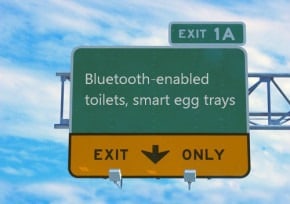
The reality is, just because we can put sensors in things and communicate the data, does not mean we should. Indeed, the list of the ridiculous is getting longer, including WiFi-enabled diapers and Bluetooth-enabled toilets.
There are some criteria that we should use when we decide that it’s a good idea to network-enable everything. It needs to be useful — meaning it solves a clear and existing problem that’s difficult to solve without IoT. Moreover, it needs to be pertinent. I mean, how hard is it to look in your fridge to see how many eggs you have left?
Putting Sense Into IoT Devices

A “smart” egg tray.
There is an obligation from those who are innovating in this space to put some thought behind what they are doing. If we try to connect to every device, or thing, then IoT will actually make our lives more complex. We’ll be so ill-equipped to deal with information coming from these devices that we’ll quickly become data-saturated.
There’s also is the issue of data sense. IoT is not about embedding sensors in things, and connecting them to the network. It’s about making sense of the gigabytes of data these devices spin off, and automating responses to that data. This includes the ability for jet-engines to report problems well before failure, or a sensor that can pick up an increasing level of CO2 before it becomes critical. In other worlds, this can be life saving stuff, and it should not be taken lightly.
So, my assertion is that we should all consider a specific set of criteria before IoT-enabling anything. This includes asking the following questions:
- Does this solve an existing problem, and can humans benefit?
- Are there manual alternatives that are just as effective?
- Is the use of the technology cost-effective?
- Is data being consumed that will provide us with a deeper understanding of the activity?
It’s not much to ask for, but I suspect we’ll see more ridiculousness in the IoT space. The market will normalize as we push back on the things that don’t need to be connected. This will hopefully divert the innovation to different and more productive directions. We need to focus on real problems, guys.
Want more? Check out our most-read content:
Frontiers in Artificial Intelligence for the IoT: White Paper
The Value of Bringing Analytics to the Edge
What’s Behind the Attraction to Apache Spark
IoT Hacking: Three Ways Data and Devices Are Vulnerable
Liked this article? Share it with your colleagues!

 Best Practices for Deploying and Scaling Industrial AIArtificial Intelligence (AI) is transforming industrial operations, helping organizations optimize workflows, reduce downtime, and enhance productivity. Different industry verticals leverage AI in unique ways.Link to The Center for Adaptive Edge Intelligence
 The Center for Adaptive Edge IntelligenceAdaptive edge intelligence brings real-time decision-making to the point of data creation, whether from sensors, machines, or cameras.Link to The Value of Vehicle Electrification
 The Value of Vehicle ElectrificationElectric vehicles (EVs) present automakers with many design, engineering, and manufactu ring challenges.Link to Accelerating Manufacturing Digital Transformation with Industrial Connectivity and IoT
 Accelerating Manufacturing Digital Transformation with Industrial Connectivity and IoTDigital transformation is empowering industrial organizations to deliver sustainable innovation, disruption-proof products and services, and continuous operational improvement.Link to Smart Manufacturing for Automotive
 Smart Manufacturing for AutomotiveLeading a transportation revolution in autonomous, electric, shared mobility and connectivity with the next generation of design and development tools.Link to Center for Data Pipeline Automation
 Center for Data Pipeline AutomationAs businesses become data-driven and rely more heavily on analytics to operate, getting high-quality, trusted data to the right data user at the right time is essential.Link to Center for Automated Integration
 Center for Automated IntegrationThe goal of automated integration is to enable applications and systems that were built separately to easily share data and work together, resulting in new capabilities and efficiencies that cut costs, uncover insights, and much more.Link to Continuous Intelligence: Insights
 Continuous Intelligence: InsightsDigital transformation requires continuous intelligence (CI). Today’s digital businesses are leveraging this new category of software which includes real-time analytics and insights from a single, cloud-native platform across multiple use cases to speed decision-making, and drive world-class customer experiences.