The company will use analytics and IoT to improve diagnostics and maintenance.
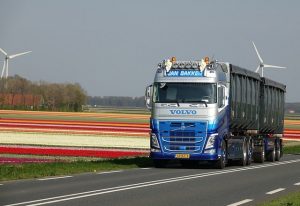
Volvo has equipped over 350,000 of its trucks with IoT sensors that collect data used for predictive maintenance and diagnostics. Onboard telematics deliver software updates to the engine via the air. The company has shrunk repair time 25% and diagnostic time 70% by employing a combination of artificial intelligence (AI) and the Internet of Things (IoT) technologies. Uptime is much improved.
Increasing Uptime and Pinpointing Issues More Effectively
In 2012, Volvo introduced a remote diagnostics service for its connected trucks. The service allows customers to send and receive information from their vehicles and monitor real-time fault codes. A system malfunction with the engine or transmission, for example, triggers a fault code. The diagnostic service collects real-time streaming data including:
- The malfunction’s specific location
- Conditions present at the time of the malfunction, like temperature, RPM level, and torque load
This granular level of data collection facilitates the provision of more comprehensive — and faster — diagnostics and repairs than traditional scheduled service appointments. Fleet operators also benefit from other information like fuel consumption, driving habits, and overall vehicle performance.
Volvo hopes to help customers maximize their vehicles’ time on the road while also minimizing service directions with this service.
OTA Software Update Delivery
Volvo has also launched a remote programming service that uses cellular service to deliver over-the-air (OTA) software and parameter updates. And the company has joined forces with SAS to provide an advanced stream processing and AI platform.
See also: Predictive Maintenance: The Continuous Intelligence Killer App
Of each truck’s hundreds of sensors, Volvo identified 75 worth close monitoring. These specific sensors offer important information about critical failures. Trucks leverage a telematics communication gateway via OTA to send data directly to the company’s dedicated servers.
Data that identifies mechanical faults gets sent in near real time to a message queue where SAS Event Stream Processing gathers and processes it. The company protects data capture and processing with firewalls.
Sue Walsh is News Writer for RTInsights, and a freelance writer and social media manager living in New York City. Her specialties include tech, security and e-commerce. You can follow her on Twitter at @girlfridaygeek.

 Best Practices for Deploying and Scaling Industrial AIArtificial Intelligence (AI) is transforming industrial operations, helping organizations optimize workflows, reduce downtime, and enhance productivity. Different industry verticals leverage AI in unique ways.Link to The Center for Adaptive Edge Intelligence
 The Center for Adaptive Edge IntelligenceAdaptive edge intelligence brings real-time decision-making to the point of data creation, whether from sensors, machines, or cameras.Link to The Value of Vehicle Electrification
 The Value of Vehicle ElectrificationElectric vehicles (EVs) present automakers with many design, engineering, and manufactu ring challenges.Link to Accelerating Manufacturing Digital Transformation with Industrial Connectivity and IoT
 Accelerating Manufacturing Digital Transformation with Industrial Connectivity and IoTDigital transformation is empowering industrial organizations to deliver sustainable innovation, disruption-proof products and services, and continuous operational improvement.Link to Smart Manufacturing for Automotive
 Smart Manufacturing for AutomotiveLeading a transportation revolution in autonomous, electric, shared mobility and connectivity with the next generation of design and development tools.Link to Center for Data Pipeline Automation
 Center for Data Pipeline AutomationAs businesses become data-driven and rely more heavily on analytics to operate, getting high-quality, trusted data to the right data user at the right time is essential.Link to Center for Automated Integration
 Center for Automated IntegrationThe goal of automated integration is to enable applications and systems that were built separately to easily share data and work together, resulting in new capabilities and efficiencies that cut costs, uncover insights, and much more.Link to Continuous Intelligence: Insights
 Continuous Intelligence: InsightsDigital transformation requires continuous intelligence (CI). Today’s digital businesses are leveraging this new category of software which includes real-time analytics and insights from a single, cloud-native platform across multiple use cases to speed decision-making, and drive world-class customer experiences.