Name of Organization: Fast Retailing
Industry: Retail
Location: Yamaguchi City, Japan
Business Challenge:
Fast Retailing Company, a leading clothing retailer knowretan for its Uniqlo brand of international clothing stores, wanted to improve customer service by replacing manual searches for merchandise with a real-time retail solution. The goal was to improve customer experience and business intelligence by:
- Automating its corporate inventory system
- Automating its sales reporting
- Increasing productivity through better employee time management
The retailer sought to provide employees with handheld devices not only to check stock inventory in real time, but also access information such as product descriptions and daily sales data. Otherwise, customers have to wait while employees manually check stock shelves for items or look up information on a PC.
Fast Retailing, established in 1963, now operates 960 international clothing stores with 40,000 employees. Along with real-time inventory lookups, the company seeks to encourage all of its employees to think like managers. “To gain a manager’s perspective, they need access to information that they can use to make decisions,” says Shoji Okada, director of the business information systems division at Fast Retailing.
Solution:
When it came to increasing employee productivity and accessing inventory, the company had to determine whether to use an existing smartphone product or to develop a proprietary device. “Uniqlo currently introduces several hundred items each season, each with variations in color and size,” says Okada. “It would be impossible to manage that many products using a smartphone.”
Hardware design was equally important. Smartphones often break when dropped, and the company wanted a durable device. The solution also had to be easy to use. “Since you would check forms from the terminal, a large, easy-to-read screen was necessary,” says Okada. “Also, it was important to balance lightness and portability with durability. Finally, it had to have a design that would not look out of place in a Uniqlo store.” In other words, a UPS or construction-site device would not fit in at Uniqlo, which has a bright, modern vibe.
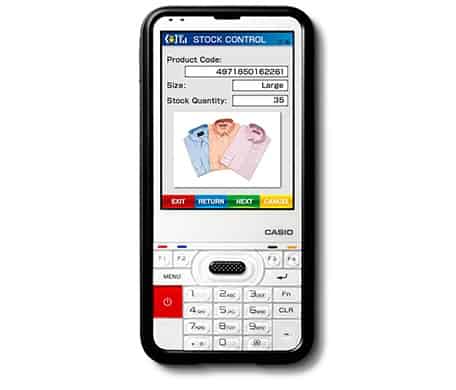 Casio’s IT-300.
The company designed and implemented a solution involving a handheld Casio device, which runs the Microsoft Windows Embedded Handheld operating system. The device draws data from Microsoft SQL Server. The Casio IT-300 is similar to a smartphone, and includes a barcode scanner and a large LCD screen. Employees can use both the touch screen and keypad to enter information, which enhances usability for a wide range of users. The solution was rolled out to all Uniqlo stores after three months of testing.
The proprietary application has a wide range of functions that employees can use to manage the ordering, receiving, and inventory of products and to check daily prices. They can also access a “Product Handbook” for details about the characteristics of each product. The company plans to expand implementation across the entire Fast Retailing group, reaching 40,000 employees.
Benefits From This Initiative:
Uniqlo store employees worldwide can use handheld devices to immediately check stocked merchandise and provide customers the most current inventory and price information. The system provides real-time access to stock checks, customer orders, sales figures, returns, deliveries, and inventory.
Employees also benefit from improved workflow. Instead of using PC terminals to clock in and out, Uniqlo employees can now use their Casio IT 300 handheld devices. “Before, lines would form as employees waited to clock in and out at the stores,” says Okada. “But we were able to solve this problem with a small, multi-functional terminal that employees carry in their pockets.”
(Source: Microsoft)
Want more? Check out our most-read content:
Frontiers in Artificial Intelligence for the IoT: White Paper
Making Every Moment Count for Customers
Shutterstock Gets the Real-Time Data Picture
What’s Behind Disney’s Real-Time Magic
Liked this article? Share it with your colleagues!

 Best Practices for Deploying and Scaling Industrial AIArtificial Intelligence (AI) is transforming industrial operations, helping organizations optimize workflows, reduce downtime, and enhance productivity. Different industry verticals leverage AI in unique ways.Link to The Center for Adaptive Edge Intelligence
 The Center for Adaptive Edge IntelligenceAdaptive edge intelligence brings real-time decision-making to the point of data creation, whether from sensors, machines, or cameras.Link to The Value of Vehicle Electrification
 The Value of Vehicle ElectrificationElectric vehicles (EVs) present automakers with many design, engineering, and manufactu ring challenges.Link to Accelerating Manufacturing Digital Transformation with Industrial Connectivity and IoT
 Accelerating Manufacturing Digital Transformation with Industrial Connectivity and IoTDigital transformation is empowering industrial organizations to deliver sustainable innovation, disruption-proof products and services, and continuous operational improvement.Link to Smart Manufacturing for Automotive
 Smart Manufacturing for AutomotiveLeading a transportation revolution in autonomous, electric, shared mobility and connectivity with the next generation of design and development tools.Link to Center for Data Pipeline Automation
 Center for Data Pipeline AutomationAs businesses become data-driven and rely more heavily on analytics to operate, getting high-quality, trusted data to the right data user at the right time is essential.Link to Center for Automated Integration
 Center for Automated IntegrationThe goal of automated integration is to enable applications and systems that were built separately to easily share data and work together, resulting in new capabilities and efficiencies that cut costs, uncover insights, and much more.Link to Continuous Intelligence: Insights
 Continuous Intelligence: InsightsDigital transformation requires continuous intelligence (CI). Today’s digital businesses are leveraging this new category of software which includes real-time analytics and insights from a single, cloud-native platform across multiple use cases to speed decision-making, and drive world-class customer experiences.