

























































































































































































































Challenges and drivers for CI
Every business operating today must transform into a digital business or risk being disrupted. The transition to digital operations generates an unprecedented volume of data from every touchpoint, customer interaction, and digital connection across the entire business and its ecosystem.
To put the data volumes into perspective, consider that data, in general, is expected to grow exponentially through 2025 to 175ZB. But from a continuous intelligence perspective, an estimated 30% of all data by 2025 will be machine data generated by digital transformation technologies and solutions. Percentage-wise that represents about a doubling of such data.
All this data (much of it endlessly streaming) must be collected, indexed, analyzed, securely stored and safeguarded, and transformed into meaningful business value. Companies that can accomplish this will find that the data offers an incredible opportunity to know exactly what is happening inside a business the moment it happens.
Such information is critical in today’s marketplace. Employees across organizations are always increasingly accountable for the overall health and security of their businesses. They can no longer credibly hide behind intelligence gaps caused by the plethora of function-based, outdated analytics tools that deliver siloed, piecemeal, and lagging insights. Organizations that cannot close these gaps in intelligence will get left behind and get lapped.
As companies rely on speed and agility for success, a business imperative is emerging to unlock the intelligence layer hidden inside their functions, teams, leaders, and employees so it can act as a unified source of faster innovation, higher creativity, real-time responsiveness and execution success. Access to this layer must be real-time, continuous, and supported by a single source of truth that brings siloed data together in a common, seamless, and always-on experience.
To close intelligence gaps, companies are unlocking their intelligence layer with continuous intelligence. Continuous intelligence can deliver real-time insights and enables organizations to accelerate their digital transformation and the ubiquitous shift to cloud computing and modern application architectures.
Embracing an architectural transformation
Increasingly, cloud-native is the architecture of choice to build and deploy modern applications that transform businesses. The architecture provides the speed and flexibility needed to develop, deploy, continuously improve and secure applications to stay competitive and meet user expectations, essential requirements for businesses operating new services in a digital world.
The benefits of cloud-native applications realize the promise of truly distributed application architectures with almost infinite scalability and elasticity than their inflexible, monolithic counterparts.. Cloud-native applications are a collection of small, independent, and loosely coupled services, making use of microservices and containers that use cloud-based platforms as the preferred deployment infrastructure.
Microservices provide the loosely coupled application architecture, which enables deployment in highly distributed patterns. Additionally, microservices support a growing ecosystem of solutions that can complement or extend a cloud platform.
Another aspect of a cloud-native deployment is the use of serverless computing. Serverless computing is a cloud-computing execution model in which the cloud provider runs the server and dynamically manages the allocation of machine resources. From a modern application perspective, serverless is an event-driven environment in which containers are loaded and executed based on some condition being triggered. For example, that condition might be an API call or the time of day.
Using an architectural approach that embraces these technologies delivers several benefits, including:
Faster development and deployment: Time to market is a critical differentiator in today’s marketplace. Cloud-native applications using modern DevOps techniques allow businesses to automate many aspects of application development, testing, and deployment. As a result, businesses can quickly create new applications and rapidly deploy them. Thus, they can react to market changes and meet changing customer priorities.
Reduced costs: Cloud-native applications benefit from containerization. Why? Containers make it easy to manage and secure applications independently of the infrastructure that supports them. Increasingly, businesses are using Kubernetes to manage containers and resources in the cloud. When Kubernetes and containers are combined with enhanced cloud-native capabilities such as serverless deployment, businesses can run dynamic workloads and pay-per-use for compute time in milliseconds. This ultimate flexibility in pricing is enabled by cloud-native.
Flexibility to incorporate new technologies: Businesses need to keep pace with rapid changes in the field. That may require adding new analytics methods to enhance the capabilities of an application. For instance, a customer support service hub might want to incorporate different voice capabilities (e.g., speech to text features and vice versa using newly available natural language processing routines). A cloud-native architecture would use APIs to easily connect different (and new) analytics solutions offered as microservices.
Flexibility also includes the ability to scale and burst “at will” to handle the unpredictable business cycles of on-demand services. There are numerous examples where such capabilities are needed including ramping up capacity and service for Black Friday, Cyber Monday, a sporting event like the Super Bowl, Presidential elections, or a natural disaster. Flexibility also is needed to adjust to major market disruptions such as those brought on with the onslaught of Covid.
The critical role of continuous intelligence
The many benefits of such an application architecture shift show why the cloud-native approach is popular and gaining more converts every day. However, cloud adoption introduces new issues that can render traditional management, monitoring, and troubleshooting solutions obsolete. Such solutions are either overwhelmed, present too many false alerts, or miss critical insights completely.
As such, continuous intelligence solutions are needed. They typically offer several features, characteristics, and benefits attuned to the needs of modern business today. Specifically:
- Modern application architectures break workloads down into small components and distribute them across cloud environments. This creates complexity, introducing more components, systems, and signals to manage, capture and analyze. Continuous innovation requires continuous intelligence to speed quality improvements and better manage these complex systems and services.
- Multi-cloud adoption drives digital sprawl due to siloed architectures and management tools that provide only partial views, do not operate in real-time, and are not scalable for cloud environments. Multi-cloud agility requires continuous intelligence to enable a single pane of visibility across the entire heterogeneous architecture environment in real-time and across multiple use cases.
- Security complexity arises as the surface area of attack expands across a perimeter-less digital footprint. Organizations often lack the skilled analysts and cloud-native tools needed to secure this new world. Today’s increasingly sophisticated threats require continuous intelligence to automate and speed threat detection and response and to filter the real threats from the noise.
- Collaboration becomes more important as teams struggle with antiquated, siloed systems that only present a partial view of data and lack real-time context around what is happening broadly across their organization. Continuous collaboration requires continuous intelligence to enable all functions to operate with contextual insights from a single source of truth – their modern application – to speed decision-making and eliminate time wasted debating which data from which tool source is relevant.
- The overwhelming volume of data continues to grow unabated, and while companies must store and secure it, they are ill-equipped to extract value from it. Continuous data requires continuous intelligence to transform a burden into real-time value that can contribute to business success and competitive advantage, addressing various intelligence needs across innovation, operations, security, and customer experience use cases.
Who needs continuous intelligence?
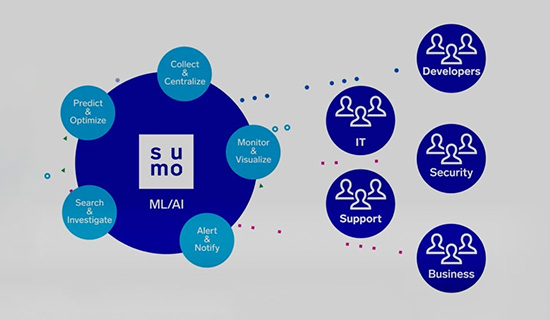
Many personas can use continuous intelligence within an organization for different purposes. Examples include:
- Developers can use continuous intelligence to build better software faster by gaining end-to-end observability across logs, metrics, and traces to find root causes.
- Security staff and analysts can use continuous intelligence to automatically triage alerts, detect threats across all data sources, and speed up incident investigations.
- IT operations staff and site reliability engineers can use continuous intelligence to maintain the high reliability of applications and infrastructure.
- Line of business leaders can use continuous intelligence to track their business service level indicators (SLIs), key performance indicators (KPIs) and key risk indicators (KRIs) in real-time to serve and optimize business operations across all parts of a digital enterprise.
CI also is a powerful tool for others. For example, cloud architects can use continuous intelligence to accelerate cloud adoption by gaining real-time monitoring of their migrated workloads in the cloud. And compliance officers and teams can use CI to quickly and easily demonstrate compliance readiness and maintain security best practices. CI application areas
Businesses using continuous intelligence can have insights into all operational areas. Some of the main uses of CI include:
- Operational intelligence for DevOps observability: Continuous intelligence can help reduce downtime by finding, investigating, and resolving customer-impacting issues faster with real-time alerting and dashboards for all data, including logs, metrics, traces, meta data and telemetry.
- Security intelligence: Continuous intelligence provides real-time analytics and security insights for apps and infrastructure. It can be used to support the entire spectrum of security use cases—from logging compliance data to monitoring and securing hybrid clouds to modernizing Security Operations Centers (SOCs) with automated threat detection, incident investigation and threat hunting.
- Business intelligence: Continuous intelligence can help companies make smarter business decisions faster by harnessing the data available throughout the organization to improve time to market for new features and offerings, better understand customer patterns and behaviors, and track business SLIs, KPIs and KRIs to understand real-time business performance of digital operations and services.
Why CI and why now?
CI is being more widely adopted across many industries and for many applications. The reason: the trifecta of mega trends of cloud computing, continuous innovation and microservice architectures, and proliferation of devices and endpoints from mobile computing and IoT is causing a perfect storm of data volume, velocity, variety, sources and tools. Businesses now have huge amounts of streaming data that are ripe for collection, indexing, analysis and inclusion in business processes. And a new set of modern application and infrastructure technologies (cloud, container, orchestration, database, storage, custom code, services and security) to make use of that data are now emerging and gaining adoption traction.
The combination of lots of streaming data and solutions to derive actionable intelligence from that data means CI can deliver significant benefits to businesses of all types and sizes. For example, a financial institution could use CI for real-time fraud prevention by detecting malicious transactions and stopping them before they are executed. An online retailer could use CI to provide an enhanced customer experience and improved service when a customer contacts a call center or moves through the product selection and purchasing process online. Or a utility could use CI to optimize resources and dynamically load shift and load balance in real-time as energy demands surge (or drop) throughout the day.
The bottom line is that continuous intelligence helps businesses make decisions while events are happening. It brings meaning to real-time data and helps organizations in a wide variety of industries.