Best Practices for Deploying and Scaling Industrial AI
Artificial Intelligence (AI) is transforming industrial operations, helping organizations optimize workflows, reduce downtime, and enhance productivity. Different industry verticals leverage AI in unique ways.
Accelerating Manufacturing Digital Transformation with Industrial Connectivity and IoT
Digital transformation is empowering industrial organizations to deliver sustainable innovation, disruption-proof products and services, and continuous operational improvement.
Leading a transportation revolution in autonomous, electric, shared mobility and connectivity with the next generation of design and development tools.
As businesses become data-driven and rely more heavily on analytics to operate, getting high-quality, trusted data to the right data user at the right time is essential.
The goal of automated integration is to enable applications and systems that were built separately to easily share data and work together, resulting in new capabilities and efficiencies that cut costs, uncover insights, and much more.
Digital transformation requires continuous intelligence (CI). Today's digital businesses are leveraging this new category of software which includes real-time analytics and insights from a single, cloud-native platform across multiple use cases to speed decision-making, and drive world-class customer experiences.
Best Practices for Deploying and Scaling Industrial AI
Artificial Intelligence (AI) is transforming industrial operations, helping organizations optimize workflows, reduce downtime, and enhance productivity. Different industry verticals leverage AI in unique ways.
Accelerating Manufacturing Digital Transformation with Industrial Connectivity and IoT
Digital transformation is empowering industrial organizations to deliver sustainable innovation, disruption-proof products and services, and continuous operational improvement.
Leading a transportation revolution in autonomous, electric, shared mobility and connectivity with the next generation of design and development tools.
As businesses become data-driven and rely more heavily on analytics to operate, getting high-quality, trusted data to the right data user at the right time is essential.
The goal of automated integration is to enable applications and systems that were built separately to easily share data and work together, resulting in new capabilities and efficiencies that cut costs, uncover insights, and much more.
Digital transformation requires continuous intelligence (CI). Today's digital businesses are leveraging this new category of software which includes real-time analytics and insights from a single, cloud-native platform across multiple use cases to speed decision-making, and drive world-class customer experiences.
If anyone is confused about the promise and peril of the “Internet of Things,” a vending machine is a good example.
Vending is estimated to be a $42 billion business in the United States, but walk anywhere and you’ll still see old-style vending machines that accept only quarters. Or maybe the dollar-bill interface doesn’t work, or if it does, it won’t take your rumpled bill.
But let’s say you’re in luck — you’ve got $1 in quarters — only this time, the machine is out of the drink you want. There’s an entire list of roadblocks, in fact, standing between you and obtaining a simple $1 item. And those hurdles aggravate vending owners also, as they mean lost sales.
Intel’s approach
The most sophisticated operation a traditional vending machine performs is accepting quarters and indicating “sold out.”
But it could be much smarter if given a bit of processing power, an updated interface, and a connection to the Internet.
That’s the approach of Intel, one of the leading IoT companies in the smart vending space. Intel has partnered with Pepsi, N&W Global, and Costa Coffee (the world’s second-largest coffee chain) on smart vending machines.
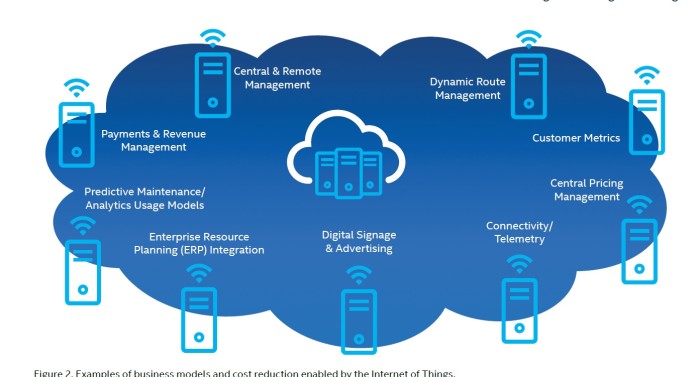
As illustrated by Intel’s reference architecture, smart vending encompasses multiple IoT use cases:
Photo credit: Intel
Condition-based maintenance
Predictive and condition-based maintenance is a huge IoT use case, especially in the manufacturing, energy, and oil and gas industries. With low oil prices, for example, margins in the oil industry on production have been extremely low. Although vending machines cost much less than an oil well—usually a few thousand dollars—operating margins are also razor-thin with vending. The average monthly income from a vending machine, for example, is reportedly around $25. If the machine is out of service, all monthly income could be lost.
Inventory problems in retail are a huge challenge: Will the store have enough of a product to sell to customers without unnecessary overhead? Intel offers central pricing management as well as route management with its vending technology. For example, Intel worked with Costa Express coffee bars on vending machines that support telemetry for sending information to vending operators and company headquarters.
“Examples include sales and inventory data used for restocking and pre-kitting, alerts about component failures (e.g., refrigeration unit) or reports on cash levels. This information enables operators to improve operational efficiency, such as route optimization, preemptive repairs and cash management,” Intel stated.
Maximizing sales
The location of a vending machine often dictates the demographics of customers. For example, shopping malls have more young people; hospitals have more elderly; highway rest areas have a broad mix. But unless vending operators “personally study customer interactions, they may not truly know whether the product mix they offer is maximizing sales,” Intel said.
Here, Intel offers an optional “audience impression metrics suite” that shows how vending users are responding to the touchscreen on the vending device.
“The software aggregates viewer statistics by gender, age range, impression counts, and dwell times, information that can be used to play directed advertisements and measure campaign effectiveness, as well as determine lost sales from customers who walked away without making a purchase,” Intel stated in a solution brief. “This is all done anonymously and while respecting viewer privacy,”
Advertisement
Customer experience
Intelligent touchscreen vending machines from Intel partner PepsiCo, for example, have large HD displays for playing commercials, helpful messages, and other content (such as nutritional information). “Users can also charge their mobile devices directly from the machine by plugging into specially designed AC power outlets and USB ports. In addition, users can play an on-screen game (random chance) for the opportunity to win a free beverage,” Intel said in a solution brief.
“It is possible to get customers to spend more by making improvements to traditional vending machines, like cashless payment, cross-selling promotions, loyalty cards, couponing, easy-to-use touchscreens and digital signage, among others,” the company said.
Intel’s smart vending architecture
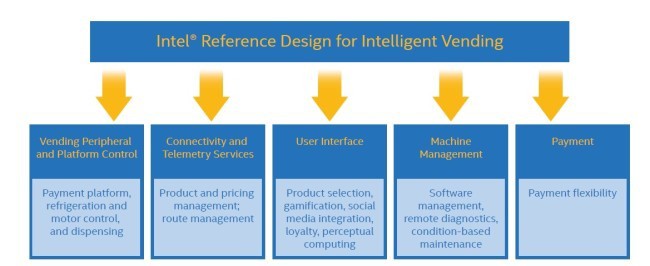
Intel offered another example of how a smart vending machine enables multiple IoT use cases by design:
Credit: Intel
The design can work with either new or legacy machines, Intel said. Under the architecture, an Intel-processor based platform with a VMI board replaces traditional vending machine controllers, and provides machines with wired Ethernet or broadband wireless connectivity to the outside world.
Vending peripheral control – including temperature and motor — is handled by VMI board, Intel explained. The other main functions – connectivity and telemetry, touch interface, and machine management – are carried out by applications running on the processor-based platform.
A high-level API handles variations in protocols, such as Multidrop Bus (MDB, a protocol frequently used in vending machines). In other words, “the HLAPI allows vending machine manufactures to make rather easy configuration changes to support bus protocols that were modified by peripheral vendors,” Intel explains. (Interoperability is a huge challenge in the IoT, as a universe of protocols exist for different devices).
Advertisement
Intel technologies featured in its smart-vending design include a content management system (CMS) to compose vending messages; its audience impression metrics suite; Intel AMT, which enables remote monitoring, management and in some cases repair of corrupted software; and McAfee embedded control for security.
The reference design runs on Wind River Linux, but also supports Microsoft Windows.
Conclusion: cool stuff, but can you afford It?
As previously mentioned, operating margins in many businesses can be small. Add to that the fact that enterprise IoT projects cost enormous amounts of capital, and no wonder businesses want to see a “fast time to value” for projects.
“Analytics used to be a competitive advantage, but now it’s becoming table stakes,” Steve Allan, head of analytics for Silicon Valley Bank, said in the study.
In this week’s real-time analytics news: The Apache Software Foundation (ASF) announced that Apache Auron, Apache Reqsign, and Apache ResilientDB have become Top-Level Projects (TLPs).
A real-world approach to unlocking agentic AI’s value must center on identifying actual business problems, then building unified agentic platforms that can address them.
Analysis and market insights on real-time analytics including Big Data, the IoT, and cognitive computing. Business use cases and technologies are discussed.
Advertiser Disclosure: Some of the products that appear on this site are from companies from which TechnologyAdvice receives compensation. This compensation may impact how and where products appear on this site including, for example, the order in which they appear. TechnologyAdvice does not include all companies or all types of products available in the marketplace.